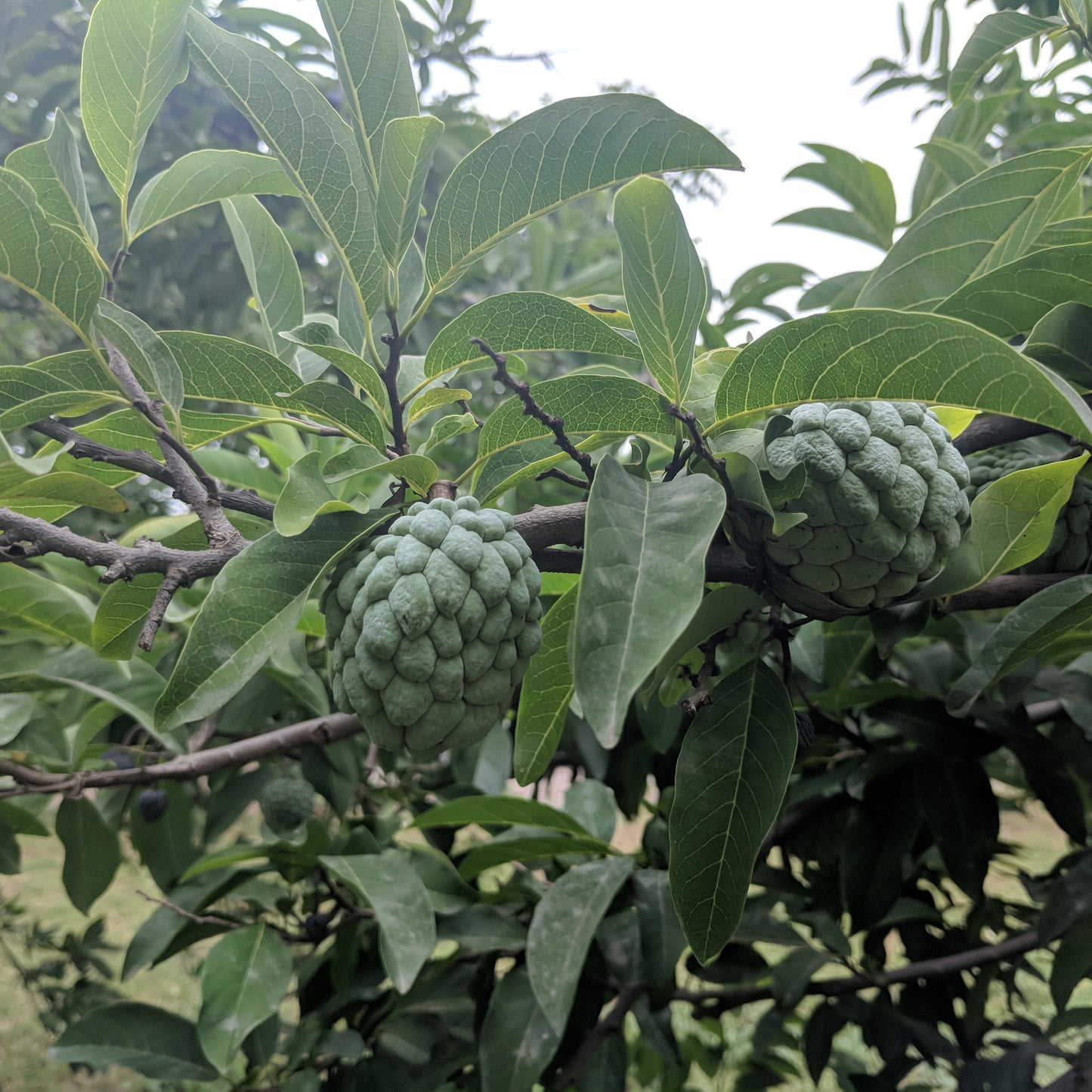
Tropical treasure with sweet custard-like fruit and ornamental beauty
About Annona squamosa
Annona squamosa, commonly known as the Sugar Apple or Custard Apple, is a delightful tropical fruit tree prized for its sweet, creamy fruit and ornamental qualities. Native to the tropical Americas—particularly Central America and the Caribbean—it has become a global favorite in warm climates, offering both culinary delights and aesthetic appeal in gardens and landscapes worldwide.
The tree is a semi-deciduous to evergreen small tree, reaching 6-8 meters tall with a rounded, spreading canopy. It produces heart-shaped fruits (6-10 cm across) with distinctive scaly skin covering white, custard-textured segments around black seeds. Each fruit contains 50-70% edible pulp, with a sweet flavor profile reminiscent of vanilla and custard—hence its common names.
🌴 Native Heritage & Global Distribution: Originating from tropical Americas, the species has naturalized across over 100 countries spanning tropical belts worldwide. Major production centers include India, Brazil, the Philippines, and parts of southern United States. It thrives in tropical and subtropical environments, favoring warmth with moderate rainfall, typically between 750-1,500 mm annually, and performs best at elevations from sea level up to 1,500 meters.
Remarkably adaptable, Annona squamosa demonstrates physiological resilience: deep roots access groundwater during droughts, it tolerates seasonal moisture stress via controlled leaf shedding, and unique photosynthetic adaptations enhance drought tolerance. The tree is ideal for home orchards, ornamental landscapes, agroforestry systems, and container cultivation, adapting beautifully from seed to mature specimen over 3-5 years.
Seed Propagation & Germination Guide
Seed Collection & Viability
Collect seeds from ripe, healthy fruits to ensure genetic quality. Extract seeds by scooping pulp, rinse thoroughly in water to remove inhibitors, and air-dry for 1-2 days in shade. Test viability using float method (viable seeds sink) or tetrazolium assay—target 70%+ viability. Store dry seeds at 4-10°C in airtight containers for up to 6 months.
Pre-Germination Treatments
Raw seeds germinate at rates below 20% due to hard seed coats. Mechanical scarification (nicking with sandpaper, 50-60% success) or hot water treatment (55°C for 30 minutes, 60-75% success) effectively break dormancy. Chemical scarification with 98% sulfuric acid (10-15 minute soak, then rinse) achieves 70% germination. For enhanced results, combine treatments with gibberellic acid (GA3) soaks.
Sowing Medium & Planting
Use sterile, well-aerated seed mix: 50% cocopeat + 50% perlite or coarse sand. Plant seeds 1-2 cm deep in trays or pots with drainage. Keep substrate moist but not waterlogged. Label trays for record-keeping. Water via bottom-up irrigation to prevent damping-off fungal issues.
Temperature & Humidity Control
Optimal temperature: 25-30°C soil (use heat mats for stability). Humidity: Maintain 80-90% via plastic domes or closed propagators. Provide indirect light (500-1000 lux) to prevent seed scorch. Ventilate daily to prevent mold. Fluctuations below 20°C halve germination rates.
Germination Timeline
Under optimal conditions (28°C, 85% RH), expect testa rupture in 10-15 days, with full emergence (radicle protrusion) by 21-35 days. Untreated seeds take 40-60 days. Hormonal aids reduce germination time to 7-10 days for 50% germination. Seasonal variations occur: faster in spring warmth, slower in excess moisture.
Seedling Care
Post-germination, provide bright shade (50% light), maintain 24-28°C, and consistent moisture. Harden off after 4 weeks via gradual sun exposure. Fertilize weekly with diluted (1/4 strength) balanced NPK (10-10-10) from week 3. Transplant to 10 cm pots at 10-15 cm height (6-8 weeks) when 2-4 true leaves form. Prune tips for bushiness; watch for aphids.
Advanced Propagation: Grafting
For faster fruiting (1-2 years vs. 3-5 from seed), use grafting on rootstocks like A. montana or A. glabra. Whip grafting in spring onto 1-year-old rootstocks achieves 70-80% success. Vegetative propagation via air layering (with rooting hormone) produces clones maintaining fruit quality within 3 months.
Cultivation & Care Guide
Light Requirements
Full Sun (6-8 hours direct): Essential for fruiting and optimal growth; yields drop below 20 fruits/tree with insufficient light.
Partial Shade (4-6 hours): Suitable for juveniles; use reflective mulches in cloudy seasons to boost 20% more light.
Artificial Lighting: For indoor pots, position 30-50 cm under 400-600W HID or LED grow lights (14-16 hours/day) for 50-100% yield vs. outdoors.
Temperature & Hardiness
Optimal range: Day 25-35°C; night 18-24°C for growth and fruit set. Below 15°C, metabolism slows; above 38°C, pollen sterility rises 50%. Cold tolerance: Mature trees survive brief -2°C to 0°C exposures (2-4 hours), but foliage blackens, fruit aborts. USDA zones 10a-11b; marginal in 9b with protection. Protect seedlings from frost; use windbreaks, wrapping, or heaters in cold climates.
Soil & Nutrition
Ideal soil: Well-drained loamy sand or clay loam (60% sand, 20% silt, 20% clay) with 20-30% organic matter. pH 5.5-7.0 (slightly acidic-neutral); amend with lime for <5.5, sulfur for >7.5. Nutrient needs: Juveniles require high N (3:1:2 NPK); adults prefer balanced 1:1:1 during fruiting with K emphasis (1:0.5:2) for quality. Annual needs: 100-200 g N/tree. Organic approach: 5-10 kg compost/tree/year. Micronutrients: Add chelated Fe, Zn, Mn if chlorosis appears.
Watering & Drainage
Establishment: Weekly deep soaks (20-30 L/tree). Mature trees: Bi-weekly in dry seasons; adjust based on soil probe (moist 10-20 cm deep). Moderate drought tolerance—survives 2-3 months dry via leaf drop, but yields drop 50%. Drainage: Essential to prevent Phytophthora root rot; use raised beds or slopes (5-10% grade). Add perlite (20%) to pots. Avoid waterlogging; soil should never sit in standing water.
Humidity & Air Circulation
Optimal humidity: 70-90% for pollination and disease prevention. Below 50%, mist daily or use pebble trays. In dry areas, install drip foggers; greenhouses maintain via humidistats. Airflow: Ensure adequate ventilation to prevent fungal outbreaks like anthracnose. Prune for open canopy allowing light penetration.
Pruning & Maintenance
Annual deep prune post-harvest (remove 20% canopy) encourages branching and productivity. For container trees, prune to 1.5-2 m height for manageability. Remove only yellow or dead fronds/branches. The tree naturally sheds old fronds seasonally—this is normal. Sanitize tools between cuts. Maintain mulch (10 cm) to suppress weeds, conserve moisture (30% savings), and suppress soil pathogens. Monthly inspections for pests; rotate pots quarterly for even growth (indoor containers).
Pest & Disease Management
Common issues: Anthracnose (dark lesions on fruits, humid weather trigger), Phytophthora root rot (waterlogging), scale insects, mealybugs, fruit borers (larvae tunnel fruits). Prevention: Prune for airflow, use resistant rootstocks, fruit bagging (95% borer efficacy). Treatment: Neem oil (2-5 ml/L) for aphids/mealybugs (weekly sprays, 3 applications); copper fungicides pre-bloom for anthracnose; spinosad for borers. IPM approach: Monitor thresholds (5 pests/leaf), rotate chemicals, encourage predators (ladybugs). Organic: BT for caterpillars, Trichoderma biofungicide for roots.
Container Growing & Indoor Cultivation
Excellent for pots (10-20 gallons) or planters indoors and on patios. Use south-facing windows or grow lights (6+ hours equivalent). Maintain 21-30°C, 60-80% RH via humidifiers. Water when top 5 cm soil dries; fertilize monthly (half-strength 20-20-20). Repot every 2-3 years in spring (gently remove, trim circling roots, fresh mix of coco coir:perlite 2:1). Pollinate manually with brushes for fruits. For wintering in cooler homes, reduce water (bi-weekly), withhold fertilizer, place in coolest room (15-20°C) with max light. Leaf drop in winter is normal dormancy.
Quick Reference Summary
Botanical Name
Annona squamosa
Common Names
Sugar Apple, Custard Apple
Family
Annonaceae
Origin
Tropical Americas
Light
Full Sun (6-8 hours)
Temperature
25-35°C (optimal)
First Fruit
2-5 years from seed
Seller
VIRIAR.COM
VIRIAR.COM
Premier Provider of Exceptional Exotic and Rare Seeds Worldwide
Specializing in authentic, carefully curated germplasm selected with meticulous precision and unwavering commitment to quality excellence.
At VIRIAR, we specialize in delivering premium tropical plants, exotic palms, and rare seeds from our nursery in Topoľníky, Slovakia to plant enthusiasts worldwide. Every shipment is carefully packaged with phytosanitary certificates and expert care instructions to ensure your plants arrive healthy and ready to thrive.
Live Plant Shipping Expertise
We've perfected the art of shipping live tropical plants internationally. Each plant is bare-rooted, wrapped in protective materials, and shipped with moisture-retaining packaging. Our plants are quarantine-certified and come with all necessary documentation for customs clearance.
Global Delivery Network
Real-time tracking from our nursery in Slovakia to your doorstep anywhere in the world
Live Shipments
Active Routes7
Countries Served190+
Avg. Delivery Time6-8 days
Success Rate99.7%
Plants in Transit247
45,000+
Plants Delivered
€45
Starting Shipping Cost
24/7
Tracking Available
100%
Insured Shipments
Our Trusted Shipping Partners
Expert Packaging
Professional bare-root prep, moisture control, protective wrapping for long journeys.
Packaging Process
Roots cleaned & trimmed
Moist sphagnum moss wrap
Bubble wrap protection
Breathable plastic seal
Insulated box cushioning
Phyto Certificates
Official EU certificates and health inspections for international transport.
Documents Included
EU phyto certificate
Health inspection report
CITES permit if needed
Customs invoice
Species ID labels
Live Tracking
Track plants from nursery to doorstep with real-time updates.
Track & Trace
SMS & email alerts
Live GPS location
Delivery time window
Customs status
Delivery photo
Climate Control
Weather monitoring and insulated packaging for temperature protection.
Temperature Safety
Thermal insulation boxes
Heat/cold packs ready
Weather monitoring
Safe range: 5-30°C
Delay if extreme
Care Guide
Detailed planting instructions and aftercare tips included.
Complete Manual
Step-by-step planting
Zone hardiness map
Watering schedule
Soil mix recipe
24/7 expert support
Guarantee
100% alive arrival promise or free replacement.
Our Promise
100% alive arrival
Free replacement
Full refund option
Photo proof in 24h
10+ years trusted
Choosing a selection results in a full page refresh.