Phallus hadriani (Dune Stinkhorn)
Phallus hadriani (Dune Stinkhorn)


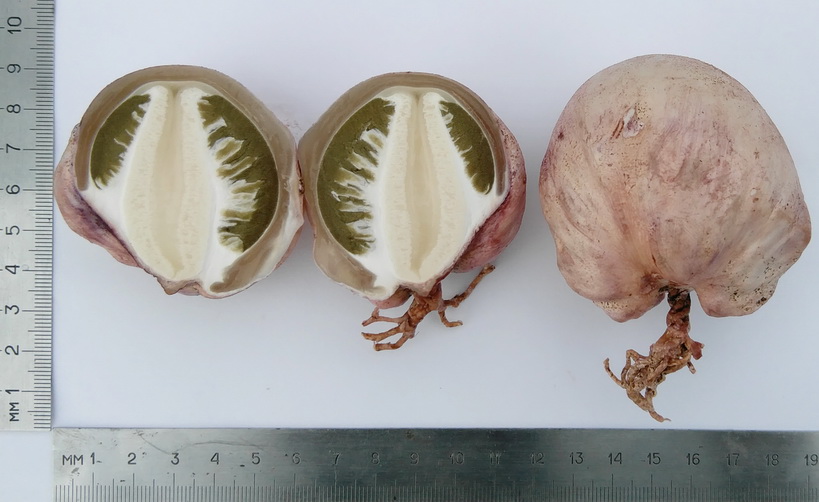


Table of Contents
- Introduction
- Identification Guide
- Taxonomy & Classification
- Edibility & Safety
- Look-Alikes & Confusions
- Habitat & Ecology
- Foraging Guide
- Cultivation
- Culinary Uses
- Preservation & Storage
- Medicinal Properties
- Seasonal Fruiting
- Spore Print & Microscopy
- Varieties & Forms
- History & Ethnomycology
- Beginner's Guide
- FAQ
🍄 Introduction
Phallus hadriani, the dune stinkhorn or pink-egg stinkhorn, closely resembles the common stinkhorn but is distinguished by its pinkish-lilac egg peridium and preference for sandy, open habitats. Like P. impudicus, it produces a foetid dark olive gleba to attract insects for spore dispersal. It is less common than its ubiquitous relative, occurring in sand dunes, coastal habitats, and sandy inland soils across Europe and parts of North America.
The mature fruitbody stands 10-20 cm tall with the same basic architecture as P. impudicus: a white spongy receptacle topped by a thimble-shaped, reticulate cap coated in dark olive-green gleba. The egg is 3-6 cm in diameter with a distinctly pinkish-lilac to rosy peridium, the key diagnostic character separating it from P. impudicus. The volva retains its pink coloration at the base of the expanded fruitbody. The stench is similar in character to P. impudicus but often described as slightly sweeter, more reminiscent of overripe fruit than pure carrion.
Quick Facts
| Common Names | Dune Stinkhorn |
| Family | Phallaceae |
| Order | Phallales |
| Origin | Europe, North America |
| Edibility | Edible (Egg Stage Only) |
| Ecology | Saprotrophic |
| Spore Print | Olive-Brown |
🔍 Identification Guide
The pink-lilac color of the egg peridium is the primary identification feature — collect specimens at the egg stage or note the colored volva at the base of expanded specimens. Habitat provides strong supporting evidence: sandy soils, dune systems, coastal environments, and sandy waste ground are characteristic. The smell at maturity is stinkhorn-typical but may have a slightly sweeter quality. Slicing the egg reveals the standard stinkhorn compressed primordium in gelatinous matrix.
Morphological Features
| Feature | Description |
|---|---|
| Cap Shape | phallic spike with reticulate cap coated in fetid olive gleba, arising from pink-purple egg |
| Cap Diameter | 2-4 |
| Cap Color | white stipe, olive-black gleba on cap; egg pink-purple |
| Cap Surface | reticulate under dark gleba |
| Gill/Pore Type | none (gasteromycete) |
| Gill/Pore Color | n/a |
| Stipe Height | 8-18 |
| Stipe Diameter | 2-3.5 |
| Stipe Features | white, hollow, spongy, arising from pink to purple volva |
| Flesh Color | white |
| Odor | intensely fetid, carrion-like |
| Taste | egg stage: mild |
| Spore Print | olive-brown |
Field Identification Checklist
- Cap shape: phallic spike with reticulate cap coated in fetid olive gleba, arising from pink-purple egg
- Cap color: white stipe, olive-black gleba on cap; egg pink-purple
- Gill/pore type: none (gasteromycete)
- Gill/pore color: n/a
- Spore print: olive-brown
- Odor: intensely fetid, carrion-like
- Stipe: white, hollow, spongy, arising from pink to purple volva
Detailed Morphology
The peridium of the egg shows the same three-layered construction as P. impudicus — outer skin, gelatinous middle layer, inner membrane — but the outer layer contains pinkish-lilac pigments absent in P. impudicus. The gleba composition, spore morphology, and receptacle structure are essentially identical to P. impudicus. The reticulate cap pattern may be slightly less pronounced than in P. impudicus, though this is variable and not a reliable distinguishing feature. Rhizomorphic cords are white, as in P. impudicus.
🧬 Taxonomy & Classification
Phallus hadriani was described by Ventenat in 1798, named after the Roman emperor Hadrian, though the connection to the emperor is not explained in the original description. Some authors have treated it as a variety of P. impudicus (P. impudicus var. hadriani), but molecular and ecological evidence supports species-level distinction. The ITS sequence divergence between P. hadriani and P. impudicus is consistent with separation at species rank. The species is placed in Phallaceae within the Phallales.
⚕️ Edibility & Safety
The egg stage is edible, as with P. impudicus, and can be prepared identically — peel the outer skin and consume the gelatinous interior raw or lightly cooked. The same critical safety caution applies: always slice eggs open before consumption to confirm the stinkhorn structure and exclude Amanita eggs. The expanded fruitbody is technically nontoxic but the powerful odor renders it unpalatable. The rarity of this species compared to P. impudicus makes harvesting for food ethically questionable in areas where it is uncommon.
⚠️ Look-Alikes & Confusions
Phallus impudicus is almost identical in mature form but has a white rather than pink-lilac egg peridium. The distinction is clearest at the egg stage; once expanded, only the colored volva remnant at the base reliably separates the two species. Phallus ravenelii has a smooth rather than reticulate cap. Amanita eggs in sandy habitats are a potential danger — always slice open any egg-stage fungus and verify the compressed stinkhorn form inside.
Known Look-Alikes
| Species | Edibility | Key Difference |
|---|---|---|
| Phallus impudicus | Edible (Egg Stage Only) | Cap: white stipe, dark olive-brown to black gleba cap; Odor: intensely fetid, carrion-like; attracts flies for spore dispersal; Habitat: deciduous woodland, gardens, parks, wood chip mulch |
| Mutinus caninus | Inedible | Cap: pale pink to orange-red body, dark olive gleba at tip; Odor: unpleasant, fetid but less intense than P. impudicus; Habitat: woodland, gardens, hedgerows, decomposing wood |
🌲 Habitat & Ecology
Phallus hadriani is a saprotroph of sandy substrates, most characteristically found in coastal sand dunes, beach margins, and sandy heathlands. It also occurs inland on sandy waste ground, in sand-filled gardens, and on sandy roadside embankments. The species thrives in nutrient-poor, well-drained sandy soils where competition from other decomposers may be reduced. Mycelial cords colonize buried organic matter including dune grass roots, driftwood, and other plant debris in sand.
| Habitat | sand dunes, sandy soils, coastal areas, gardens |
| Substrate | sandy soil, buried debris |
| Ecology | Saprotrophic |
| Altitude | 0-500m |
| Climate Zones | temperate, coastal |
| Distribution | coastal Europe, North America |
Ecological Role
Phallus hadriani decomposes buried organic matter in nutrient-poor sandy ecosystems, playing a particularly important role in dune ecology where decomposition rates are generally slow. The mycelial cords bind sand particles and contribute to dune soil formation and stabilization. Insect visitors attracted by the gleba provide a link between the fungus and the dune invertebrate community. The species may help recycle nutrients from buried driftwood and seagrass in coastal dune systems.
🗺 Distribution Map
Known distribution of Dune Stinkhorn: coastal Europe, North America. This species is saprotrophic (saprotrophic).
🧺 Foraging Guide
Search sandy coastal habitats, dune systems, and sandy heathlands in summer and early autumn. The eggs are found by probing sandy soil near where mature specimens are fruiting or have recently collapsed. Pink-tinged eggs partially emerged from sand are distinctive and unlikely to be confused with other fungi in this habitat. Due to its relative scarcity and ecological sensitivity of dune habitats, foraging for consumption is not recommended — observe and photograph instead.
🌱 Cultivation
No commercial cultivation protocol exists for Phallus hadriani. The species might be encouraged by introducing colonized sandy substrate to a suitable garden bed with sandy soil, but success is unpredictable. The mycelium likely colonizes sawdust and chip substrates similarly to P. impudicus, but the specific sandy-substrate ecology may be difficult to replicate. Research on this species is limited compared to P. impudicus and the commercially grown P. indusiatus.
| Difficulty | difficult |
| Substrate | sandy soil with buried organic matter |
| Spawn Type | mycelium cord |
| Days to Fruit | 365 |
🍳 Culinary Uses
Preparation of eggs follows the same method as P. impudicus: peel the outer skin, slice the gelatinous interior, and serve raw in salads or lightly sauteed. The flavor and texture are reported to be indistinguishable from P. impudicus eggs. Given the species' relative rarity and the ecological sensitivity of its preferred dune habitats, culinary experimentation should be limited to abundant populations where harvesting a few eggs will not impact the colony. The expanded fruitbody is not used culinarily.
| Culinary Uses | egg stage: pickled, egg stage: raw |
| Preservation | pickling (egg stage) |
📦 Preservation & Storage
Fresh eggs deteriorate rapidly and should be used within hours of collection. Expanded fruitbodies dry poorly due to the spongy receptacle collapsing, though they can be preserved for herbarium purposes. The pink peridium color fades significantly upon drying, so color photographs taken at the time of collection are essential for documentation. Scientific specimens should be accompanied by notes on egg color and habitat details.
Preservation Methods
- pickling (egg stage)
🩹 Medicinal Properties
No specific medicinal research exists for Phallus hadriani, though it can be assumed to share some biochemical properties with the closely related P. impudicus. Polysaccharide and lectin content may be similar, but targeted extraction and bioactivity studies have not been conducted. The species is too uncommon to be a practical source of pharmacological compounds. Any medicinal claims extrapolated from P. impudicus research should be treated with appropriate caution.
🍂 Seasonal Fruiting
Fruiting occurs from June through October, with peak production in July and August in northern Europe. The species responds to warm, humid conditions following rainfall on sandy substrates. Individual egg-to-maturity expansion occurs in 4-6 hours, typically overnight or in early morning. Colonies may produce several flushes of eggs during a season, though total fruitbody production is generally lower than in the more prolific P. impudicus.
🔬 Spore Print & Microscopy
Basidiospores are essentially identical to those of P. impudicus: elliptical to cylindrical, smooth, hyaline to pale olive, 3.5-5 x 1.5-2.5 micrometers. The gleba matrix and spore suspension are indistinguishable microscopically between the two species. Molecular markers (ITS and LSU rDNA sequences) provide definitive separation where morphological distinction is uncertain. The small spore size is shared across the genus and is consistent with the insect-dispersal strategy.
🌀 Varieties & Forms
No formally described varieties exist. The intensity of the pink-lilac peridium color varies from distinctly rosy to faintly pinkish, and weathered or waterlogged eggs may lose color and resemble P. impudicus. Some populations in inland sandy habitats produce slightly smaller fruitbodies than coastal dune populations. The degree of cap reticulation varies within populations but is not taxonomically significant.
📜 History & Ethnomycology
The species is less prominent in folklore than P. impudicus due to its restricted habitat and lower frequency of encounter. In coastal communities of the Netherlands and northern Germany, the pink eggs were occasionally noted as curiosities but not widely collected for food. The Ventenat description from 1798 established it as a distinct taxon early in the development of modern mycological taxonomy. The species gained renewed attention in the 20th century as mycologists refined the species boundaries within Phallus.
🎓 Beginner's Guide
If you find stinkhorns in sandy coastal or dune habitats, check the egg color — a pink-lilac tinge indicates P. hadriani rather than the common P. impudicus. The two species are otherwise nearly identical in mature form, so egg or volva color is the key feature to observe. Sandy habitats are fragile ecosystems, so tread carefully and avoid disturbing dune vegetation. As with all stinkhorn eggs, never consume without slicing one open first to verify the internal structure.
Photography Tips
The pink egg stage is the most diagnostic and photogenic subject — photograph eggs partially emerged from sand with the lilac peridium clearly visible. Side-by-side comparison images with P. impudicus eggs dramatically illustrate the color difference. Coastal habitats offer excellent natural lighting and sand-toned backgrounds that complement the pink coloration. For the mature stage, capture the colored volva at the stipe base, as this feature distinguishes it from P. impudicus even after the gleba has been removed by insects.
Common Mistakes
Always slice puffballs vertically to confirm pure white interior; Amanita buttons have embryonic gills inside
Many unusual fungi are conservation priorities; photograph rather than collect
Troubleshooting
Faded or weathered eggs may lose their pink coloration, making distinction from P. impudicus difficult — collect fresh, undamaged eggs for reliable identification. If the cap surface appears smooth rather than reticulate, consider P. ravenelii rather than P. hadriani. Habitat is a strong supporting character: true P. hadriani in dense woodland is unusual and warrants careful re-examination. Molecular confirmation via ITS sequencing is advisable for records from atypical habitats.
❓ Frequently Asked Questions
Can you eat Dune Stinkhorn?
Phallus hadriani is generally considered inedible due to poor taste, tough texture, or uncertain safety. It is not recommended for consumption.
What mushrooms look similar to Dune Stinkhorn?
Known look-alikes include Phallus impudicus, Mutinus caninus. Careful identification using multiple features (cap, gills/pores, stipe, spore print, habitat) is essential to avoid confusion.
Where does Dune Stinkhorn grow?
Phallus hadriani is found coastal Europe, North America. It typically grows in sand dunes, sandy soils, coastal areas, gardens during summer to autumn.
What color is the spore print of Dune Stinkhorn?
The spore print of Phallus hadriani is olive-brown. Taking a spore print is an important step in mushroom identification.
When is the best time to find Dune Stinkhorn?
Phallus hadriani typically fruits during summer to autumn. Fruiting is often triggered by rainfall followed by appropriate temperatures for the species.
📋 Summary — Phallus hadriani (Dune Stinkhorn)
Phallus hadriani, the dune stinkhorn or pink-egg stinkhorn, closely resembles the common stinkhorn but is distinguished by its pinkish-lilac egg peridium and preference for sandy, open habitats. Like P. impudicus, it produces a foetid dark olive gleba to attract insects for spore dispersal. It is less common than its ubiquitous relative, occurring in sand dunes, coastal habitats, and sandy inland soils across Europe and parts of North America.
Related Species
Phallus impudicus is virtually identical except for the white (not pink) egg peridium and preference for woodland rather than sandy habitats. Phallus ravenelii from eastern North America has a smooth cap and white egg. Phallus duplicatus has a net-like indusium and is generally found in woodland settings. Mutinus caninus and M. elegans are smaller stinkhorns without the distinct thimble-shaped cap of Phallus species.