Utricularia amethystina
Utricularia amethystina

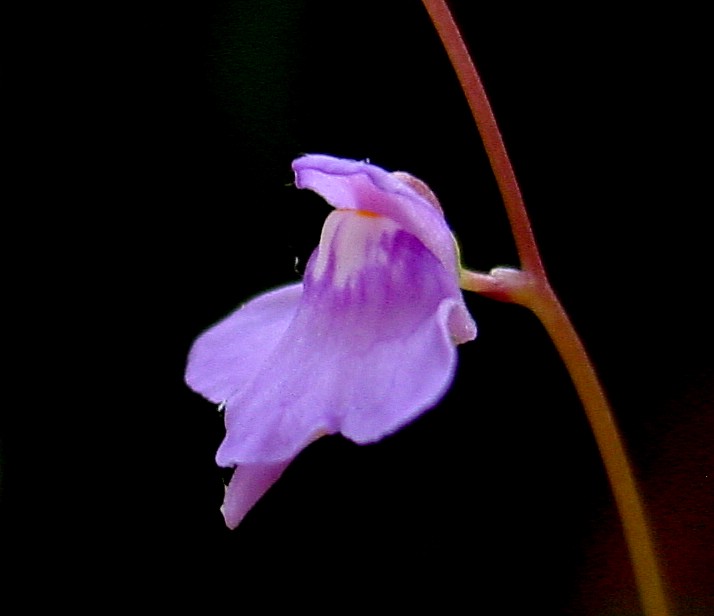

Table of Contents
Use only distilled water, reverse osmosis (RO), or rainwater — ideally under 50 ppm TDS. Tap water, bottled mineral water, and softened water contain calcium, magnesium, and sodium that accumulate in the substrate and kill carnivorous plants within weeks. This is the #1 cause of cultivation failure.
Introduction & Discovery
Utricularia amethystina is a charming terrestrial bladderwort native to tropical and subtropical regions of the Americas, from Central America through the Caribbean to Brazil, distinguished by its delicate amethyst to violet flowers that inspire its species name. As a terrestrial species, U. amethystina grows in moist, sandy, nutrient-poor soils, producing tiny, inconspicuous vegetative structures at or below the soil surface and sending up slender flower scapes bearing one to several small, jewel-like flowers. The terrestrial habit of this species contrasts with both the aquatic bladderworts that float in open water and the epiphytic species like U. alpina that grow on trees. The bladder traps are borne on underground stolons and capture microscopic soil organisms including protozoa, nematodes, and minute larvae. In cultivation, U. amethystina is one of the easier tropical terrestrial Utricularia to grow, thriving in moist peat and sand substrates with bright light and warm temperatures. Its small but beautifully colored flowers appear prolifically throughout the growing season, creating a miniature carpet of violet blooms that delights close observers.
Discovery & Naming
Utricularia amethystina was described by the French botanist Aimee Jacques Alexandre Bonpland in collaboration with Alexander von Humboldt during their famous exploration of the Americas in the early nineteenth century. The name 'amethystina' refers to the amethyst-violet flower color. The species has a wide Neotropical distribution reflecting its adaptability to diverse tropical wet habitats.
Trapping Mechanism
Employs the universal Utricularia bladder trap mechanism on underground stolons. Tiny vacuum-powered bladders, typically less than one millimeter in diameter, capture microscopic soil organisms. The trap operates by maintaining a partial vacuum inside the bladder. When trigger hairs are contacted by prey, the door opens in less than a millisecond, and the organism is swept inside by the inrushing water. The traps reset and can fire repeatedly. Digestive enzymes and bacteria within the bladder break down captured organisms.
Native Range & Distribution Map
Distribution map showing the native range of Utricularia amethystina.
Biology & Trapping Mechanism
Terrestrial annual to short-lived perennial herb. Vegetative structures largely subterranean, consisting of thin stolons with bladder traps and small, inconspicuous leaves near the soil surface. Flower scapes slender, five to fifteen centimeters tall, bearing one to five small bilaterally symmetrical flowers in shades of amethyst to violet, sometimes with white or yellow markings. Flowers measure five to ten millimeters across. Seeds minute, produced in capsules. The species can behave as an annual, completing its life cycle in a single growing season and maintaining itself through self-sown seed.
Prey & Feeding Ecology
Targets the microfauna of moist tropical soils: protozoa, rotifers, nematodes, minute arthropod larvae, and other microscopic organisms. These are abundant in the wet, sandy, nutrient-poor soils where the species grows. The nutritional contribution supports growth and flowering in nutrient-limited environments.
Comparison with Similar Species
Among terrestrial Utricularia, U. amethystina is one of the most commonly cultivated tropical species. Compared to U. alpina (epiphytic, large flowers), U. amethystina is dramatically smaller in all dimensions with a completely different growth habit. Against aquatic species like U. australis, the terrestrial lifestyle represents a fundamentally different ecological strategy. Among terrestrial species, U. amethystina is distinguished by its violet flower color from the white-flowered U. livida and the yellow-flowered U. subulata.
Reproduction & Propagation
Self-sowing is the primary propagation method. Allow flower scapes to mature and release seeds onto the moist substrate. Seeds germinate readily in warm, moist conditions. Stolon division is possible with established plants. The species maintains itself easily through seed in suitable conditions, often appearing spontaneously in pots of other tropical carnivorous plants where it has been introduced.
Cultivation & Substrate
Grow in a mix of peat and sand or peat and perlite in a two-to-one ratio. Tray water method with pure water, maintaining shallow standing water. Full to bright light. Warm temperatures of twenty to thirty degrees Celsius. Tropical species; does not tolerate cold. The species may self-sow in cultivation, maintaining itself through seed even if individual plants are annual. Seeds are best left to fall naturally on the moist substrate. Very easy to grow as a companion plant with other tropical carnivorous plants.
Substrate: Live sphagnum, peat + sand, or aquatic
Water: Distilled / Rainwater only — NEVER tap water
Light: Bright indirect to full sun
Humidity: 60-95%
Common Mistakes to Avoid
Allowing the substrate to dry out. Insufficient light causing elongated scapes and reduced flowering. Growing too cold. Using mineral-rich water. Not allowing seeds to self-sow, leading to loss of annual individuals. Some growers try to keep the substrate too wet, causing anaerobic conditions.
Seasonal Considerations
Tropical species with year-round growth in warm conditions. No dormancy needed. Maintain consistent moisture, warmth, and light throughout the year. Flowering can occur at any time but is most prolific in the warmer months with longer days. Allow seeds to self-sow for colony persistence.
Seasonal Care Calendar
🌱 Spring (Mar-May)
Water: Moderate
Feeding: No feeding
Monitor growth and adjust care as needed.
☀️ Summer (Jun-Aug)
Water: Moderate
Feeding: No feeding
Monitor growth and adjust care as needed.
🍂 Autumn (Sep-Nov)
Water: Moderate
Feeding: No feeding
Monitor growth and adjust care as needed.
❄️ Winter (Dec-Feb)
Water: Moderate
Feeding: No feeding
Monitor growth and adjust care as needed.
Diseases & Pests
Generally disease-free when grown in appropriate conditions. Algal overgrowth on the substrate can compete with the tiny plants. Good drainage and bright light prevent algae. The underground stolons are susceptible to rot in anaerobic, waterlogged conditions.
Indoor Growing & Terrariums
Easy to grow indoors under bright LED lighting with a tray water setup. Warm room temperatures suitable. The tiny flowers provide close-up interest but are small enough to require close observation. Excellent as a companion in pots with other tropical carnivorous plants. Self-maintaining through seed.
Terrarium Setup
Excellent terrarium companion plant. Grow on the surface of moist peat-sand substrate. Bright LED lighting. Warm conditions. The tiny violet flowers appear in profusion, creating a charming ground-level display. Self-sowing maintains the colony. Pair with other tropical terrestrial Utricularia and small Drosera.
Landscape & Bog Garden Use
Depending on climate, Utricularia amethystina may be grown outdoors in a bog garden or container water tray during the growing season.
Conservation & Collector Notes
Wide Neotropical distribution provides resilience against localized threats. Some populations affected by habitat conversion in tropical lowlands. Not considered globally threatened due to broad range and adaptability. Climate change may affect tropical wet savanna habitats.
Collector Notes
Valued for its prolific flowering and charming violet blooms. While individual flowers are small, the profusion of blooms creates an attractive display. Several color forms exist across the wide geographic range. Often appears spontaneously in collections as a welcome hitchhiker. A classic example of the terrestrial bladderwort growth habit.
Ethnobotany & Cultural Significance
In the tropical Americas where U. amethystina grows, indigenous communities have extensive knowledge of their local flora, though specific uses of this tiny plant are not well documented. The inconspicuous nature of terrestrial bladderworts means they are easily overlooked. Modern significance lies in the species' role in demonstrating the diversity of growth habits within Utricularia, the largest genus of carnivorous plants.
Frequently Asked Questions
Where are the traps?
The bladder traps are on underground stolons beneath the substrate surface, invisible to the naked eye. They capture microscopic organisms from the soil moisture. You will never see the trapping in action without a microscope.
Is this plant really there? I can barely see it.
Terrestrial bladderworts are mostly subterranean, with only the flower scapes and tiny surface leaves visible. The bulk of the plant exists below the substrate as a network of stolons and bladder traps. The delicate flower scapes emerging from apparently bare substrate are the main visible sign.
Will it take over my other pots?
Possibly. U. amethystina produces tiny seeds that can spread to other pots in close proximity. Most growers consider this a welcome development rather than a problem, as the violet flowers add beauty to any pot.
Does it need special care?
No, it thrives in standard tropical carnivorous plant conditions: warm, moist, bright, with pure water. It is one of the easiest tropical Utricularia species to grow.
How long do individual plants live?
The species can behave as annual or short-lived perennial. Individual plants may complete their life cycle in one growing season. The colony perpetuates through self-sown seed. Allow seeds to drop naturally onto the substrate.
Explore Our Other Encyclopedias
12,000+ expert articles on tropical & exotic plants
Quick Reference Summary: Utricularia amethystina
Golden Rule: Pure water, poor soil, maximum light. If you remember nothing else, remember this.
Utricularia amethystina is a charming terrestrial bladderwort from the tropical Americas, producing delicate amethyst-violet flowers on slender scapes above a largely invisible network of underground stolons bearing microscopic bladder traps. Easy to grow in warm, moist, bright conditions with peat-sand substrate and tray water, it self-sows prolifically and makes an excellent companion plant in tropical carnivorous plant collections.