Nepenthes edwardsiana
Nepenthes edwardsiana

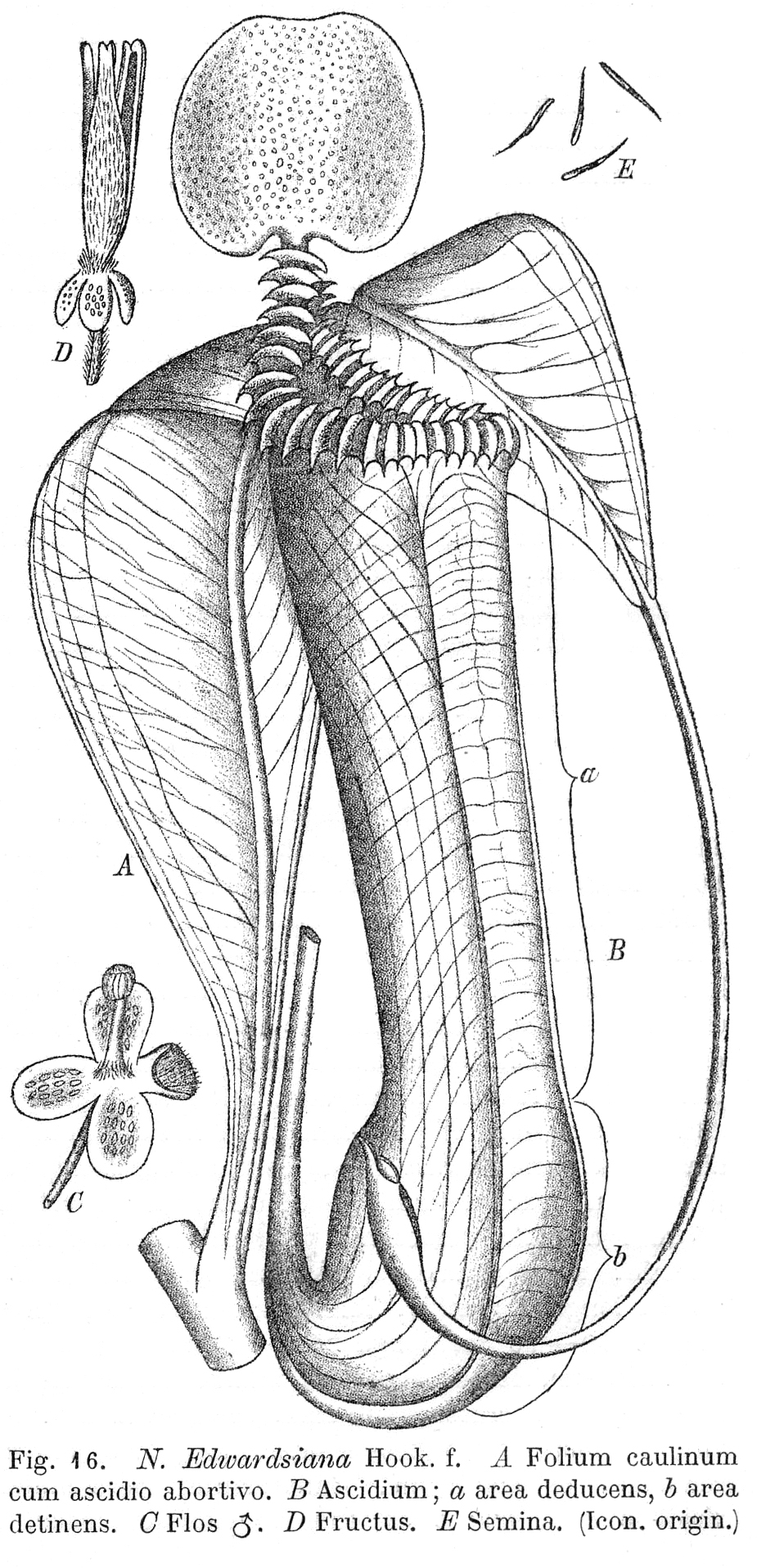
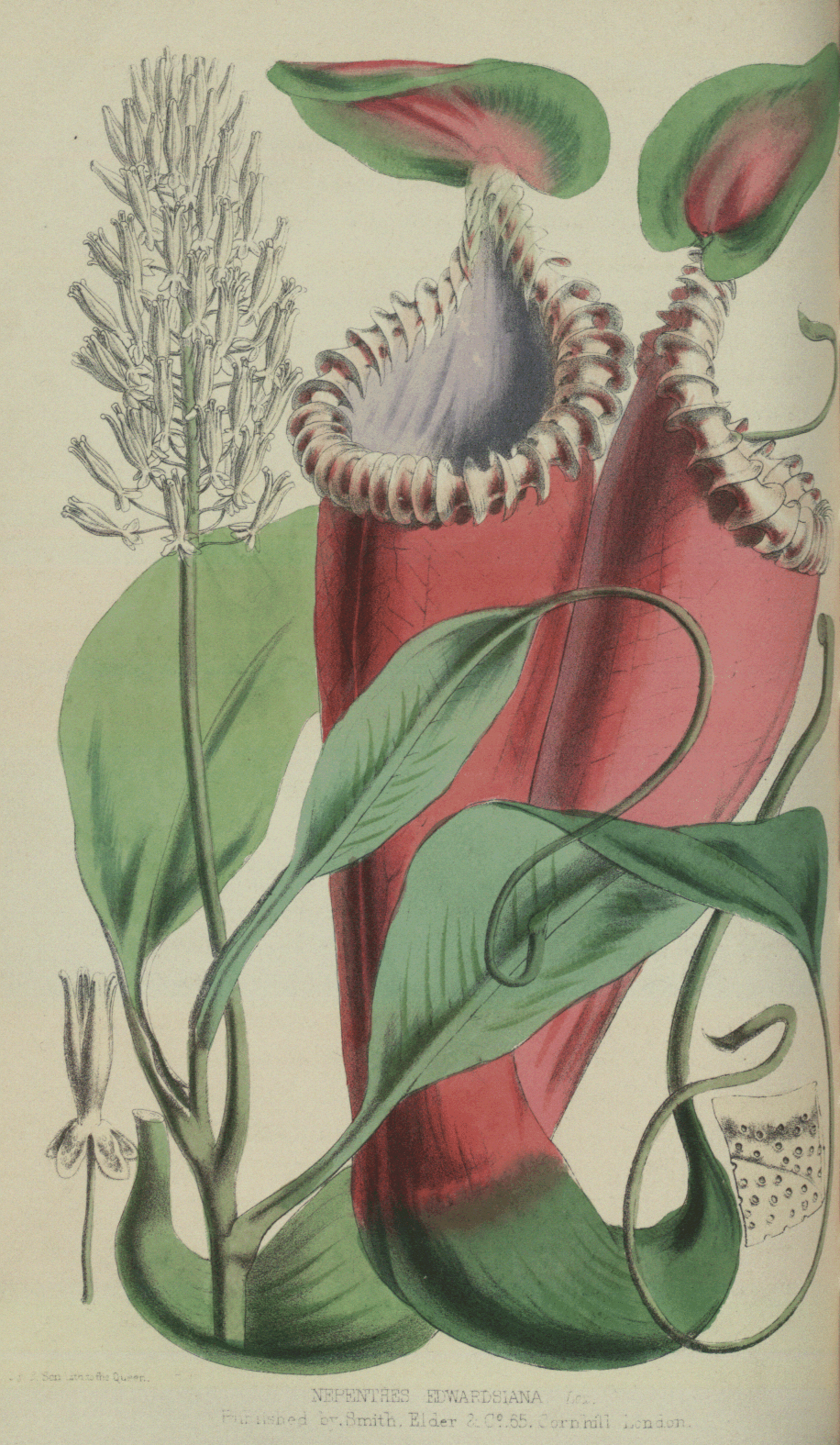
Table of Contents
Use only distilled water, reverse osmosis (RO), or rainwater — ideally under 50 ppm TDS. Tap water, bottled mineral water, and softened water contain calcium, magnesium, and sodium that accumulate in the substrate and kill carnivorous plants within weeks. This is the #1 cause of cultivation failure.
Introduction & Discovery
Nepenthes edwardsiana is the architectural summit of the entire pitcher plant genus. Where other Nepenthes merely suggest grandeur, edwardsiana delivers it in the form of a peristome so extravagantly enlarged, so aggressively ridged, and so disproportionate to the pitcher beneath it that early botanists struggled to believe specimens had not been exaggerated by preservation. The upper pitchers of mature plants are slender cylinders 25 to 50 centimetres long, culminating in a collar of raised, tooth-like ridges that can project 5 to 20 millimetres outward from the pitcher rim — a dental crown visible from metres away in the elfin forests of Mount Kinabalu and Mount Tambuyukon, Sabah, Borneo. Joseph Dalton Hooker described the species in his landmark 1859 Linnean Society monograph On the Origin and Development of the Pitcher of Nepenthes, based on material from the Hugh Low collections of 1851. Hooker placed it alongside N. rajah, N. villosa, and N. lowii in what remains the most consequential single paper ever published on the genus — a paper that established Mount Kinabalu as the botanical wonderland it is still recognised to be today. Of the four, edwardsiana is arguably the most visually arresting: its cylindrical upper pitchers, their brilliant cinnabar-red or burnished-orange colouration, and their preposterously ornamented peristomes create a silhouette unlike any other carnivorous plant on Earth. The species belongs to section Villosae alongside its closest relative Nepenthes villosa, and the two are the only members of the genus in which the peristome evolves into genuine outward-projecting teeth rather than the inward-pointing recurved ribs seen in the majority of species. For decades N. edwardsiana carried a reputation as one of the rarest Nepenthes, partly because early expeditions struggled to reach its ridge habitats and partly because some of its best stands are in extremely steep, mossy terrain that discourages casual observation. Modern surveys — particularly those by Charles Clarke, Anthea Phillipps, Anthony Lamb, and Stewart McPherson — have revised that view: on Kinabalu's northern ridges the species is locally common where habitat conditions align, though it remains globally restricted to two mountains and therefore genuinely vulnerable. Cultivation of edwardsiana in captivity is demanding but achievable. Unlike N. rajah, which tolerates intermediate conditions surprisingly well once acclimatised, edwardsiana is uncompromisingly ultra-highland: it requires consistently cool nights (ideally 8 to 14 °C) and never forgives prolonged warmth at the roots. Those growers who have succeeded describe the moment their first cylindrical upper pitcher fully opens and presents its impossible tooth-crown as one of the singular experiences in tropical horticulture. This profile is written for collectors preparing to attempt the species — or considering the investment required to do so properly — and for anyone curious about how evolution can push a single morphological feature into apparent architectural absurdity while remaining precisely functional.
Discovery & Naming
The discovery of Nepenthes edwardsiana is bound to the extraordinary 1851 Hugh Low expedition to Mount Kinabalu and to Joseph Dalton Hooker's subsequent curation of that material in the herbarium at Kew. Hugh Low, the colonial administrator and naturalist who would later become Resident of Perak, ascended Kinabalu in 1851 together with Spenser St. John — the first Europeans to reach the summit region. Low collected Nepenthes specimens obsessively during the ascent, securing type material of N. rajah, N. villosa, N. lowii, N. edwardsiana, and others, and shipped them to Hooker for description. Hooker's 1859 paper On the Origin and Development of the Pitcher of Nepenthes, read before the Linnean Society, formally named and described all these species at once and remains one of the most consequential publications in the history of plant taxonomy — the equivalent of an instant fivefold expansion of the genus's diversity, and the establishment of Kinabalu as the epicentre of Nepenthes discovery. The specific epithet edwardsiana honours an Edwards connected with the period of description; the exact individual has never been universally settled among Nepenthes scholars, and the species has retained its name for 160 years despite occasional efforts at revision. Following Hooker's description, edwardsiana remained rarely collected for decades — Frederick Burbidge saw it during his 1870s expeditions but the plant was difficult to obtain in quantity because of the steep mossy-ridge habitat. The species was virtually unknown in cultivation throughout most of the 20th century. The modern rediscovery of edwardsiana's horticultural potential begins with Kinabalu Park's establishment in 1964 (the park became a UNESCO World Heritage Site in 2000) and the gradual normalisation of research permits that allowed botanists like Anthea Phillipps, Anthony Lamb, Charles Clarke, Martin Cheek, and Alastair Robinson to re-survey the mountain across the 1980s, 1990s, and 2000s. Their work, published in Pitcher-Plants of Borneo (Phillipps and Lamb 1996, expanded with Cliff Dodd 2008) and A Taxonomic Monograph of the Nepenthaceae of Borneo (Clarke 2001), re-established edwardsiana's proper ecological context and reignited interest in bringing it into cultivation through legal tissue-culture propagation. Today Borneo Exotics, EP, and a handful of specialist nurseries offer tissue-cultured edwardsiana seedlings, though the species remains among the more expensive and slowest-growing Nepenthes on the commercial market.
Trapping Mechanism
The peristome of Nepenthes edwardsiana is both the species' signature and the key to understanding why it has become such a focus of functional-morphology research. In most Nepenthes, the peristome is a smooth, inward-curved collar of tissue whose inner surface bears microscopic radial ridges and secretes sugary nectar. When wetted by rain, dew, or the plant's own condensation, this surface becomes so slippery that insects lose their footing and aquaplane into the digestive fluid below. This wet-mode trapping, documented by Ulrike Bauer and colleagues at the University of Cambridge and the University of Freiburg (Bauer et al. 2008, 2011, 2015), is one of the most efficient passive insect-capture mechanisms in the plant kingdom. In N. edwardsiana, the peristome takes this architecture and exaggerates it to an extraordinary degree. Rather than forming a smooth collar, the peristome rises into regular, outward-projecting teeth that in mature upper pitchers reach 5 to 20 millimetres in length — comparable in scale to the entire peristome width of many other Nepenthes. Each tooth is a continuation of the peristome's radial ridging, extruded vertically and outward until it becomes a distinct structural element. The inner face of the tooth-crown retains the wet-mode slippery geometry of classical Nepenthes peristomes, meaning the trap still functions through aquaplaning once a visitor reaches the inner rim. The outward teeth themselves have been interpreted as a platform for nectar display, a structural deterrent against climbing-escape by captured prey, and a mechanical barrier that funnels approaching insects toward the inner slippery zone. Functional studies on closely related N. villosa (Bauer et al. and Thornham et al.) suggest that the teeth in section Villosae work in concert with the cylindrical pitcher body and the strongly reflexed lid: prey land on the lid's lower surface, which bears copious nectar glands and is positioned directly above the peristome; when rain activates the slippery geometry, visitors fall between the teeth and directly into the pitcher interior. The digestive fluid of edwardsiana is an aqueous proteolytic soup with modest viscoelastic properties — not the extreme mucous fluid of N. rafflesiana but more than pure water. Enzyme complements include cysteine proteases (nepenthesin I and II), chitinases, phosphatases, and nucleases, together capable of reducing insect exoskeletons and soft tissues to absorbable peptides and phosphates within 1 to 3 weeks. Upper pitchers of edwardsiana are disproportionately narrow relative to their height — a slender cylinder as much as 4 to 5 times longer than it is wide — which concentrates digestion and minimises evaporation in the cool misty conditions of the upper montane cloud forest. Lower pitchers, formed at the rosette stage, are squatter and more ovoid; they retain the tooth-crowned peristome but in less exaggerated proportion. This pitcher dimorphism — where the climbing stem produces elongated aerial traps suited to flying insects while the rosette maintains ground-level ovoid traps for crawling prey — is a hallmark of section Villosae and contributes to the species' ecological flexibility across its narrow altitudinal range.
Native Range & Distribution Map
Distribution map showing the native range of Nepenthes edwardsiana.
Biology & Trapping Mechanism
Nepenthes edwardsiana is a woody vine. Seedlings begin as small rosettes of lanceolate leaves with petite ovoid pitchers; over several years the plant develops a robust primary stem that eventually climbs by means of tendrils arising at the leaf tips. Mature climbing stems can reach 8 to 15 metres in length when supported by surrounding vegetation, though the plant's centre of gravity remains relatively low because the woody base persists at or near ground level and the climbing stem is slender. Leaves are coriaceous (leathery), oblong to lanceolate, 20 to 35 centimetres long, glabrous above and sparsely pubescent beneath, with a prominent midrib extending into the tendril. The midrib terminates in a thread-like tendril that may exceed 1 metre in length in upper pitcher-bearing nodes; at the tendril's distal end, a pitcher develops from the initial swollen primordium over 4 to 8 weeks. Upper pitchers of edwardsiana are the species' most celebrated feature: bright cinnabar red to deep orange, cylindrical, 25 to 50 centimetres tall, with a diameter of 5 to 10 centimetres, crowned by the peristome with its distinctive outward-projecting teeth. The lid is roughly circular to reniform, held reflexed at an angle slightly beyond vertical — a posture that exposes the lid's lower nectary surface to approaching insects while simultaneously protecting the pitcher mouth from rain dilution. The pitcher interior displays a distinct two-zone geometry: an upper waxy zone with epicuticular wax crystals that prevent insect escape, and a lower digestive zone lined with glands that secrete enzymes and absorb products. Lower pitchers are broader and more ovoid, 15 to 25 centimetres tall, with less pronounced peristome teeth — still visible but shorter (2 to 8 millimetres) than in upper pitchers. Flowers are borne on long erect racemes emerging from the stem at approximately metre-long intervals; individual flowers are small (6 to 8 millimetres), greenish-red to brownish, and strongly dioecious — a plant is either male or female, never both. Male inflorescences are densely many-flowered; female racemes bear fewer but larger flowers that develop into elongated capsules containing hundreds of thread-like winged seeds adapted for wind dispersal along ridge corridors. Chromosome number is 2n=80, consistent with the rest of the genus. Growth rate is famously slow: under optimum ultra-highland cultivation a seedling may take 6 to 10 years to produce its first upper pitcher, and flowering-size specimens in captivity are usually 10 to 20 years old.
Prey & Feeding Ecology
Field observations and dietary analyses on Nepenthes edwardsiana are scarcer than those on N. rajah or N. lowii because of the species' relatively inaccessible habitat, but the available data and inference from sister species indicate a diet composed predominantly of flying Hymenoptera (bees, wasps, ichneumonids, ants of the canopy layer) and Diptera (crane flies, hover flies, fungus gnats), with occasional beetles and spiders. The cylindrical upper pitchers of mature climbing stems, elevated 1 to 3 metres above the ground in the shrub layer, are positioned to intercept insects travelling along the cloud-forest understorey flight corridors; the outward-projecting peristome teeth may function partly as a visual lure in this three-dimensional space, their distinctive silhouette distinguishing edwardsiana pitchers from surrounding vegetation. Lower pitchers catch proportionally more ants, beetles, and orthopterans reflecting the crawling fauna of the moss-and-leaf-litter ground layer. Unlike its relative N. lowii, edwardsiana does not participate in known vertebrate mutualisms — no tree shrew toilet-plant interactions have been documented — and its pitcher geometry is not adapted for that service. Its trapping strategy is the older, more orthodox Nepenthes strategy: make the approach attractive, make the trap slippery, let physics do the rest. Within the pitcher fluid lives an infauna community that has been only partly characterised, but includes mosquito and midge larvae of several genera (Culex, Uranotaenia, and Forcipomyia have been reported from Kinabalu Nepenthes generally), together with rotifers, ciliates, and bacterial communities. These inquilines digest prey tissue more quickly than the plant's enzymes alone and release ammonium and phosphate into solution, which the plant absorbs through specialised cells in the pitcher's lower 'digestive zone'. Root-acquired nutrients in the ultramafic and podsolic soils of Mount Kinabalu's ridges are severely limited — particularly nitrogen and phosphorus — which is why carnivory on these substrates confers such an extraordinary competitive advantage and why Mount Kinabalu hosts one of the richest Nepenthes floras on Earth. Studies using stable-isotope analysis on Kinabalu Nepenthes have shown that prey-derived nitrogen contributes 30 to 70 percent of the nitrogen budget of a mature plant, making insect capture not a supplemental luxury but a primary nutritional pathway. Edwardsiana therefore depends on its peristome architecture for survival in a way few other plants depend on a single morphological feature.
Comparison with Similar Species
The natural comparison for Nepenthes edwardsiana is its closest relative, Nepenthes villosa. Both belong to section Villosae, both are Kinabalu endemics, both have peristomes evolved into outward-projecting teeth, both are ultra-highland, and both are among the most celebrated Nepenthes on Earth. The differences are these: N. villosa produces compact ovoid pitchers 8 to 20 centimetres tall with a broad squat profile and relatively short peristome teeth of 3 to 10 millimetres; N. edwardsiana produces elongated cylindrical pitchers 25 to 50 centimetres tall and bears peristome teeth of 5 to 20 millimetres, roughly twice as long. Villosa is often described as the more 'chunky' species, edwardsiana as the more 'elegant'. Cultivation requirements are essentially identical. In terms of horticultural accessibility, villosa is marginally easier because it is slightly more forgiving of brief warmth, but both are ultra-highland specialists. Nepenthes × kinabaluensis (rajah × villosa) is the natural hybrid most often encountered and resembles an intermediate between its parents, with the compact rajah-like body and the toothed villosa-style peristome. N. macrophylla, another ultra-highland Kinabalu (actually Mount Trusmadi) endemic, is sometimes mistaken for edwardsiana because both have large cylindrical pitchers, but macrophylla lacks the extreme peristome teeth — its peristome is broad and robust but smooth. N. rajah is the giant round-pitchered cousin, different in every respect except habitat and genus; it catches rodent faeces, edwardsiana catches insects, and their pitcher silhouettes are unmistakably different. For a grower deciding among these ultra-highland Kinabalu species, the honest recommendation is: start with N. villosa (slightly easier, faster to mature, similarly beautiful but more compact), then attempt N. rajah once ultra-highland conditions are proven, and attempt N. edwardsiana only after at least one of the preceding species has been grown successfully for 3 to 5 years. Edwardsiana is not the species with which to learn ultra-highland cultivation; it is the species with which to reward successful learning.
Reproduction & Propagation
Nepenthes edwardsiana can be propagated by seed, stem cuttings, and tissue culture, each with distinctive challenges. Seed propagation is the oldest method and, in theory, the most satisfying, but in practice it is almost never used for edwardsiana in the hobby because of three obstacles: (1) dioecious flowering means a cross requires two mature plants of opposite sex, which almost no private grower possesses; (2) wild-origin seed is CITES-regulated and generally unavailable; (3) seedlings require 6 to 10 years of perfect ultra-highland conditions before they produce meaningful upper pitchers. If seed is obtained, fresh viability is essential — Nepenthes seed loses viability quickly and rarely germinates after more than 3 to 6 months of storage. Germination is carried out on moist long-fibre Sphagnum or pure milled sphagnum in sealed transparent containers under 15 000 lux lighting at 16 to 22 °C. Germination takes 4 to 12 weeks; seedlings develop their first true pitcher at 3 to 6 months. Stem cuttings are more common for preserving specific clones. Take cuttings from climbing stems during active growth using sharp sterilised secateurs; each cutting should bear 2 to 3 nodes. Treat the cut surface with rooting hormone (IBA or NAA at 1000 ppm), insert into pure damp long-fibre Sphagnum, place in a sealed propagation chamber at 95 to 100 percent humidity and 18 to 22 °C day / 11 to 14 °C night, and provide moderate indirect light. Roots develop in 2 to 4 months; new shoots emerge from the upper node within 3 to 6 months. Success rates are moderate — commonly 30 to 60 percent — compared with easier-rooting Nepenthes. Tissue culture is the dominant commercial method. Meristem or nodal explants are established in vitro on Murashige-Skoog medium modified with reduced macro-salts, supplemented with 1 to 3 percent sucrose, BAP (6-benzylaminopurine) at 0.5 to 2 mg/L for multiplication, and transferred to IBA-containing medium for rooting. Commercial laboratories such as Borneo Exotics and Wistuba produce edwardsiana in large numbers this way; plantlets are acclimatised ex vitro over several months before sale. Tissue-cultured plants are genetically uniform clones of the source stock, chemical-free, and — crucially — entirely legal under CITES Appendix II, making them the only sensible source for private collectors.
Cultivation & Substrate
Nepenthes edwardsiana is not a beginner's plant, and attempting it without first proving the ability to maintain ultra-highland conditions with another species (such as N. villosa or N. rajah) is likely to end in failure. That said, the species is entirely achievable for a committed grower willing to invest in proper infrastructure. The core requirements are non-negotiable. Temperature: daytime 16 to 22 °C, nighttime 8 to 14 °C, year-round. A nightly drop of at least 6 to 8 °C is essential — without it the plant will gradually fail to produce pitchers, then decline in vigour, then die within 12 to 24 months. Humidity: 80 to 100 percent at night, 60 to 85 percent during the day. Air movement: constant gentle circulation from small fans is required to prevent fungal issues in this consistently moist regime. Light: 15 000 to 25 000 lux for 10 to 12 hours per day, simulating the brief cloud-break sun of Kinabalu's upper ridges. Full T5 HO fluorescent or modern horticultural LED fixtures work well; direct sunlight through glass can cause overheating and should be avoided. Water: pure (reverse-osmosis, distilled, or clean rainwater) with total dissolved solids below 30 ppm. Tap water, even in 'soft' regions, will kill edwardsiana faster than it will kill most Nepenthes because the species evolved on rain-washed ridges of exceptionally low mineral content. Substrate: a free-draining, acidic, aerated mix of long-fibre Sphagnum moss, perlite, large-grade pumice, and orchid-grade fir bark in roughly 3:2:2:2 proportion, with the pot elevated on feet to guarantee that no stagnant water sits in the saucer. Some growers successfully use pure live long-fibre Sphagnum; the critical point is that the roots must never experience warm stagnant conditions. Feeding: edwardsiana does not need to be fed regularly by the grower — in the correct environment its own pitchers will catch the small number of insects the plant requires. If feeding is desired (for example in a sealed terrarium with no insects), small quantities of rehydrated freeze-dried bloodworms or crushed betta-fish pellets may be placed directly into mature pitchers every 4 to 6 weeks during active growth. Foliar feeding with very dilute MaxSea or similar (quarter-strength, every 3 to 4 weeks) is tolerated by acclimatised plants but is not necessary and increases risk if conditions are imperfect. Repotting: every 2 to 3 years into fresh medium, handled gently because the root system is fine and fragile. The ideal time is early in the growing season when the plant is actively producing new leaves.
Substrate: Sphagnum, perlite, orchid bark
Water: Distilled / Rainwater only — NEVER tap water
Light: Bright indirect to full sun
Humidity: 60-90%
Common Mistakes to Avoid
The five mistakes that account for nearly all edwardsiana failures in captivity are, in order of frequency: (1) Insufficient nighttime cooling. Growers who provide the correct daytime conditions but let nighttime temperatures stay above 16 °C will watch their plants slowly stop producing pitchers, then stop producing new leaves, then collapse. The plant is physiologically committed to a circadian rhythm involving a cool dark phase for photosynthate translocation and root function. Without it, the carbohydrate balance becomes unsustainable. Remedy: invest in a wine-cooler, dedicated climate-controlled enclosure, or mountain-room setup capable of dropping to 10 to 14 °C every night year-round. (2) Mineral-rich water. The species evolved on substrates bathed in cloud-condensate water of near-zero TDS. Even relatively soft tap water will cause progressive root damage manifesting as leaf tip burn, reduced pitcher production, and eventual root decline. Remedy: reverse-osmosis water with a TDS meter confirming below 30 ppm, every watering, no exceptions. (3) Substrate compaction. Over time Sphagnum collapses, perlite settles, and air porosity drops. The roots, which are finely branched and oxygen-hungry, respond to anoxia with crown rot. Remedy: repot proactively every 2 to 3 years rather than waiting for visible decline; elevate pots to ensure drainage. (4) Heat spikes during transport or temporary environmental failure. A single afternoon at 28 to 32 °C can set a mature edwardsiana back months, and prolonged exposure to those temperatures is often fatal. Remedy: never ship or move the plant during summer without insulated coolers; back up climate-control equipment with redundancy (secondary fan, backup thermostat). (5) Attempting to grow it from seed without specialised infrastructure. Nepenthes seeds germinate unreliably outside a controlled environment, and edwardsiana seedlings require identical ultra-highland conditions for the entire 6 to 10 years before upper pitcher development — a commitment most hobbyists cannot sustain. Remedy: purchase tissue-cultured seedlings already 2 to 4 years old from reputable sources (Borneo Exotics, Wistuba, EP) rather than attempting seed starts.
Seasonal Considerations
Nepenthes edwardsiana is an equatorial cloud-forest plant and does not experience a pronounced seasonal cycle in nature — conditions on Mount Kinabalu fluctuate more diurnally than seasonally, with cloud cover and precipitation varying modestly through the year but temperature remaining within a narrow band month after month. In cultivation this means the plant expects consistency rather than variation: year-round ultra-highland conditions without dormancy. That said, subtle seasonal adjustments improve performance. In the temperate-zone grower's winter, when the outside environment is cold and dry, take advantage of the cheap nighttime cooling by setting thermostats slightly lower (night low of 9 to 11 °C, day high of 16 to 19 °C) — this mimics the slightly cooler January-February dry season on Kinabalu and stimulates denser pitcher production. In summer, when the ambient environment is warm, increase watering frequency slightly, raise humidity, and verify that cooling equipment has redundancy. The summer months are the period of highest risk for ultra-highland Nepenthes because a single cooling failure during a heatwave can be fatal. Light cycle: 11 to 12 hours year-round. Do not impose a photoperiod shift as one might for bog plants; edwardsiana does not respond to photoperiod the way temperate carnivores do, and abrupt changes disturb the circadian balance. Feeding: the plant feeds itself when provided with live insects in a greenhouse or outdoor mountain-room setting. In sealed chambers where no prey is available, feed every 4 to 6 weeks with a single small prey item placed into a mature upper pitcher; suspend feeding during months of slower growth. Repotting: best performed in spring (March-April in the northern hemisphere) when temperatures and daylight are optimal for root recovery. Flowering: mature plants (10+ years old) flower once they reach reproductive size; because the species is dioecious, seed production requires two plants of opposite sex flowering simultaneously and is effectively impossible for most private growers.
Seasonal Care Calendar
🌱 Spring (Mar-May)
Water: Moderate
Feeding: No feeding
Monitor growth and adjust care as needed.
☀️ Summer (Jun-Aug)
Water: Moderate
Feeding: No feeding
Monitor growth and adjust care as needed.
🍂 Autumn (Sep-Nov)
Water: Moderate
Feeding: No feeding
Monitor growth and adjust care as needed.
❄️ Winter (Dec-Feb)
Water: Moderate
Feeding: No feeding
Monitor growth and adjust care as needed.
Diseases & Pests
Nepenthes edwardsiana has relatively few disease problems when grown correctly, but certain failure modes are characteristic enough to merit direct mention. Root rot (Phytophthora, Pythium, and related oomycetes) is the single most common fatal disease and almost always results from substrate compaction combined with insufficient drainage or insufficiently aerated medium. Symptoms begin with a subtle darkening and softening at the stem base, followed by progressive leaf yellowing from the bottom of the plant upward, then collapse of the entire aerial structure within 2 to 4 weeks. By the time the grower notices, the root system is usually gone. Prevention is absolute: repot every 2 to 3 years into fresh mix, elevate pots, avoid overwatering, and maintain constant air circulation. Crown rot, a related but distinct pathology, affects the growing point directly and manifests as a wet blackened central tissue. It is often caused by water pooling in the crown overnight at cool temperatures. Prevention: water in the morning rather than evening, and ensure overhead fogging systems do not drench the crown. Fungal leaf spots (Colletotrichum, Alternaria) occasionally appear on older leaves as brown circular lesions. These are usually cosmetic; affected leaves should be removed and disposed of, and airflow increased. Algal bloom inside pitcher fluid is harmless to the plant but can indicate excessive light exposure directly on the pitcher interior. Pitcher collapse — pitchers failing to open or collapsing shortly after opening — is usually a symptom of environmental stress rather than disease, most commonly insufficient humidity or excessive dry air movement over the pitcher mouth during development. Pest problems: aphids occasionally infest new growth, responding well to targeted water rinsing or mild insecticidal soap (neem-based products are generally well tolerated by Nepenthes in short exposures, though test on a single leaf first). Mealybugs can establish in sheltered leaf axils and are more difficult to eradicate; physical removal with cotton swabs dipped in isopropyl alcohol is effective for small infestations. Scale insects are rare on edwardsiana but possible; treatment is similar to mealybugs. Spider mites can be a problem in excessively dry conditions but are effectively prevented by the high humidity the species requires anyway. Fungus gnats thrive in the moist substrate but are generally harmless to established plants; sticky traps and a top dressing of perlite reduce populations.
Indoor Growing & Terrariums
Growing Nepenthes edwardsiana indoors — outside of a greenhouse — is possible but requires dedicated equipment. A regular windowsill will fail every time: the species cannot tolerate ambient household temperatures of 20 to 25 °C at night, and even the coolest household environments do not provide the obligatory nightly drop below 15 °C. The realistic options for an indoor grower are: (1) A climate-controlled terrarium or converted wine cooler (see terrarium_setup section) — the most common approach, cost-effective for 1 to 3 plants, fits in a closet or spare-room corner. (2) A dedicated 'mountain room' — a small insulated room (2 to 5 square metres) retrofitted with a mini-split air conditioner programmed for ultra-highland temperatures. This scales well for collections of 10 or more plants and allows walking-in access for maintenance. (3) A purpose-built 'highland chamber' from specialist suppliers — large investment but minimal DIY work. For any of these, the essential monitoring equipment is: a dual-stage thermostat with min/max recording, a hygrometer, a data logger for nighttime temperature verification, and a backup alarm to alert the grower when temperatures exceed 20 °C. Placement within the chamber: edwardsiana benefits from elevated positioning to maximise air circulation beneath the foliage and to facilitate inspection of the root zone. Stakes or trellises support climbing stems as they develop. Expected growth rate indoors: very slow but steady — 4 to 8 new leaves per year on established plants, with upper pitchers emerging after 4 to 6 years of post-establishment growth from tissue-cultured rosettes. Patience is the single most important tool in the indoor edwardsiana grower's arsenal. Pairings: the species tolerates and indeed thrives alongside other ultra-highland Nepenthes such as N. villosa, N. rajah, N. lowii, N. burbidgeae, and N. macrophylla in the same climate-controlled enclosure. Mixed plantings improve visual impact and make environmental control easier because all plants share the same requirements.
Terrarium Setup
A functional edwardsiana enclosure combines a sealed or semi-sealed chamber, active cooling, active lighting, and constant air circulation. A typical hobbyist setup uses a converted wine cooler or a custom-built insulated cabinet of 60 to 120 litres internal volume. Example build: (1) Enclosure — a commercial upright wine cooler with the wine racks removed and the interior lined with HDPE or fibreglass panels to prevent corrosion. Alternatively, a purpose-built acrylic-panelled cabinet with 25 mm insulated walls. (2) Cooling — the wine cooler's thermoelectric or compressor cooling system handles the basic temperature maintenance; for more demanding stability, a separate small peltier cooler or a mini-split AC head cycling on a thermostat gives tighter control. (3) Thermostat — a dual-stage digital thermostat (Inkbird ITC-308 or similar) programmed for 18 °C day / 11 °C night with a gradual 1-hour ramp. (4) Lighting — horticultural LED at 15 000 to 25 000 lux measured at the pitcher plane, photoperiod 11 hours, full spectrum with strong 440 and 660 nm output. Lights mounted above the chamber and separated from the growing space by a sheet of acrylic reduces heat transfer. (5) Humidity — achieved passively by the sealed enclosure and damp substrate; supplemented with a small ultrasonic fogger on a timer for 10 minutes every hour during the day. A hygrometer verifies 80 to 95 percent. (6) Air circulation — a small 12 V computer fan on low speed running continuously, positioned to create gentle circulation without directly blasting the plants. (7) Substrate and pot — 3 litre plastic pot with abundant drainage holes, elevated on plastic feet 2 cm above the water tray, filled with the standard mix (long-fibre Sphagnum, perlite, pumice, fir bark). (8) Watering — top-down watering with RO water every 3 to 5 days, allowing the substrate to approach damp-not-wet between waterings. Alternative approach: open mountain-room setups in which an entire room is climate-controlled to ultra-highland conditions. This scales better for large collections but requires more expensive infrastructure and proportionally higher running costs.
Landscape & Bog Garden Use
In tropical climates (USDA zones 10–12), Nepenthes edwardsiana can be grown outdoors in a shaded, humid garden setting. Mount on trees, grow in hanging baskets, or plant in a raised bed with excellent drainage.
Conservation & Collector Notes
Nepenthes edwardsiana is assessed as Endangered on the IUCN Red List, reflecting its extremely restricted geographic range (essentially two mountains), the small size of its total population, and the historical pressure from collecting. The species is protected within Kinabalu Park and the adjacent Crocker Range Park, both of which are strictly managed by Sabah Parks and provide some of the most effective in-situ conservation for any Nepenthes. Unlike many other Nepenthes whose habitats face deforestation, agricultural conversion, or mining pressure, edwardsiana's high-elevation ridges on protected mountains face relatively few direct threats. The principal ongoing concerns are: (1) climate change, which may gradually shift the cool cloud-forest zone upward beyond the altitude available on the mountains, compressing the species' available habitat; (2) illegal collecting, which has diminished sharply since park protection but persists at a low level; (3) possible fire and storm damage in the ridge ecosystems, which become more severe as climate change intensifies; and (4) trampling and disturbance from increasing ecotourism, though well-managed trails mitigate this. CITES lists the species on Appendix II, which regulates but does not prohibit international trade; in practice, Malaysia does not issue export permits for wild material, making the only legal commercial source tissue-cultured plants from within Malaysia or from CITES-registered propagators elsewhere. Ex-situ conservation in botanic gardens is gradually increasing; collections at the Royal Botanic Gardens Kew, Atlanta Botanical Garden, and various specialist institutions maintain living reference specimens of known provenance. The overall outlook is cautiously positive: wild populations are stable where protected, tissue culture provides a legal supply for the horticultural trade without pressure on wild plants, and the species' charisma ensures it receives scientific and popular attention disproportionate to its small population size. Responsible cultivation from legal propagated sources is actively supported by the conservation community.
Collector Notes
Nepenthes edwardsiana occupies a specific niche in the Nepenthes collector's hierarchy: it is considered one of the three or four most prestigious ultra-highland species (alongside N. rajah, N. villosa, and N. macrophylla), its price premium is among the highest in the hobby, and well-grown specimens are genuinely rare in private collections outside a small circle of dedicated ultra-highland specialists. Commercial tissue-cultured seedlings typically sell for €80 to €250 for 2 to 4-year-old plants; established specimens with visible upper pitchers command €500 to €1500 or more depending on size and quality. The market supports several named clones originating from different provenance collections — Kinabalu forms, Tambuyukon forms, and the occasional 'giant' or 'red' selection identified at point of origin. These clonal distinctions matter to serious collectors because phenotypic differences in peristome tooth length, pitcher colour intensity, and ultimate upper-pitcher dimensions are real and heritable. Natural hybrids involving edwardsiana include N. × harryana (edwardsiana × villosa), which combines the elongated pitcher shape of edwardsiana with the compact robustness of villosa and is itself a prize specimen when available. Cultivation of N. × kinabaluensis (rajah × villosa) is sometimes confused with edwardsiana by beginners because both occur on Kinabalu and have dramatic pitchers, but the two are morphologically distinct once compared side-by-side. CITES status is Appendix II, which means legal international trade is permitted with proper permits; ethical collectors should always purchase from reputable nurseries with clear provenance documentation and should avoid wild-collected material regardless of apparent price advantage. The IUCN Red List assesses edwardsiana as Endangered, partly because of its restricted distribution and partly because of past collection pressure, though the establishment of Kinabalu Park has stabilised the wild population considerably. Long-term collector perspective: edwardsiana is a lifetime species. A tissue-cultured plant purchased today will require 5 to 10 years of perfect conditions before it reaches upper-pitcher stage, and 15 to 25 years before it reaches full mature dimensions. Growers who commit to the species and provide stable ultra-highland conditions are typically rewarded with a plant that outlives the climate-control equipment that sustained it.
Ethnobotany & Cultural Significance
Nepenthes edwardsiana plays no significant role in the traditional ethnobotany of the indigenous Dusun, Kadazan, or Rungus peoples of Sabah, reflecting the species' habitat in high ridges that fall outside the zones of daily human activity. The broader cultural significance of Nepenthes in Borneo is more closely associated with the lowland species N. ampullaria and N. mirabilis, whose pitchers are traditionally used as rice-cooking vessels (the pitchers impart a subtly fragrant starch coating), medicinal remedies, and children's toys. The highland species, including edwardsiana, remained largely outside traditional use until the 20th-century botanical explorations brought them into European consciousness. In modern Sabah, Nepenthes collectively are a major point of ecotourism pride: Kinabalu Park's guided walks and the Mesilau Nature Resort feature Nepenthes viewing as a primary attraction, and the species — rajah, villosa, edwardsiana, and others — appear on postage stamps, guidebooks, and promotional imagery for the region. Scientific ethnobotany in the wider sense has begun to recognise that local naturalists and parataxonomists possess substantial practical knowledge of Nepenthes habitats, and several recent publications acknowledge the contributions of Dusun and Kadazan field assistants who have guided botanists to productive collection sites over many decades. Within the global horticultural community, N. edwardsiana has acquired an almost mythic status among enthusiasts: owning one is a mark of serious commitment to the hobby, and sharing photographs of mature upper pitchers on Nepenthes forums and social media generates significant attention. This cultural elevation within a specialised community parallels the treatment of rare orchids, cycads, or bonsai trees and speaks to the way particular plant species can carry outsized symbolic weight among those who cultivate them.
Frequently Asked Questions
Can Nepenthes edwardsiana be grown without a dedicated climate-controlled chamber?
Practically speaking, no. The species requires nightly temperatures below 14 °C year-round, which is impossible to provide in almost any temperate-zone indoor environment without active cooling. Wine coolers, converted refrigerators, mini-split-equipped rooms, or purpose-built mountain chambers are the only realistic options. Growers who attempt edwardsiana in ambient room conditions invariably lose the plant within 1 to 2 years, regardless of other care quality.
Why are the peristome teeth so extreme in this species compared to others?
The current functional hypothesis, supported by comparative work on section Villosae, is that the teeth extend the nectar-display surface and channel approaching insects into the slippery inner peristome zone. The elaborate geometry may also represent sexual selection or species recognition in a genus where pollination involves small flies attracted partly by pitcher morphology. The evolutionary origin appears to be a single ancestral elaboration of normal peristome ridges, shared with N. villosa.
Is wild-collected Nepenthes edwardsiana ever legal?
Under CITES Appendix II, international trade in wild-collected edwardsiana requires export permits from the country of origin (Malaysia) and import permits from the destination country. In practice, Malaysia does not issue commercial export permits for wild N. edwardsiana because of its Endangered conservation status and the protection afforded by Kinabalu Park. Any wild-origin plant offered outside Malaysia should be considered illegally sourced. Tissue-cultured plants from reputable laboratories are fully legal and ethically sound.
How long until a tissue-cultured plant produces the famous upper pitchers?
Expect 5 to 10 years from the typical 2-to-4-year-old tissue-cultured plant sold today. The lower pitchers of immature rosettes are already attractive and show developing peristome teeth, but the dramatic elongated cylindrical upper pitchers only form once the plant has developed a climbing stem and has reached a minimum stem length of several metres.
What is the best substrate mix for Nepenthes edwardsiana?
The most reliable mix is 3 parts long-fibre New Zealand or Chilean sphagnum, 2 parts coarse perlite, 2 parts pumice (5 to 15 mm grade), and 2 parts orchid-grade fir bark. Some growers use pure live long-fibre sphagnum successfully in high-humidity chambers. The critical requirements are maximum aeration, acidic pH (4.0 to 5.5), and complete absence of mineral salts or fertiliser residues.
Does edwardsiana really need nighttime cooling every single night of the year?
Yes. The plant evolved under conditions where nighttime temperatures of 8 to 14 °C occur essentially every night on Mount Kinabalu. Brief warm periods (1 to 3 days) during summer heatwaves are survivable if the plant is otherwise healthy, but sustained nighttime warmth above 15 °C for more than a week or two causes progressive physiological decline. Designing around this constraint is the principal engineering challenge of keeping the species in captivity.
Is Nepenthes edwardsiana dioecious, and why does that matter?
Yes. A given plant is either male or female, never both, and this is only determined when the plant first flowers after 10 to 20 years of growth. This matters for seed production — you need two mature plants of opposite sex flowering at the same time — which is why virtually all commercial edwardsiana are tissue-cultured clones rather than seed-grown. If you're buying multiple plants hoping to breed, you have roughly a 1-in-4 chance of getting the necessary pair, and only after a decade or more of growth.
What is the best way to start with this species if I've never grown ultra-highland Nepenthes before?
Do not start with edwardsiana. Start with Nepenthes villosa or Nepenthes macrophylla — both are ultra-highland, both are beautiful, both will reveal whether your climate-control setup actually provides the conditions you think it does. After 2 to 3 years of successful villosa cultivation, you will have a proven environment and the practical experience to justify attempting edwardsiana without risking a significant financial investment on a plant you are not yet equipped to grow.
Explore Our Other Encyclopedias
12,000+ expert articles on tropical & exotic plants
Quick Reference Summary: Nepenthes edwardsiana
Golden Rule: Pure water, poor soil, maximum light. If you remember nothing else, remember this.
Nepenthes edwardsiana is the most architecturally extreme pitcher plant in the genus, endemic to Mount Kinabalu and Mount Tambuyukon in Sabah, Borneo, and distinguished by outward-projecting peristome teeth 5 to 20 millimetres long on slender cylindrical upper pitchers reaching 50 centimetres in height. Described by Joseph Dalton Hooker in 1859 from the Hugh Low expedition material, the species belongs to section Villosae alongside its closest relative N. villosa. It is an ultra-highland specialist requiring year-round cool nights (8 to 14 °C) and cool days (16 to 22 °C), pure low-TDS water, free-draining substrate, and 80 to 100 percent humidity. CITES Appendix II, IUCN Endangered, protected in Kinabalu Park. Cultivation is demanding but achievable with proper climate control; tissue-cultured plants are available from specialist nurseries and represent the only ethical and legal source. A lifetime species for the committed collector who has already proven competence with N. villosa or another ultra-highland Nepenthes.