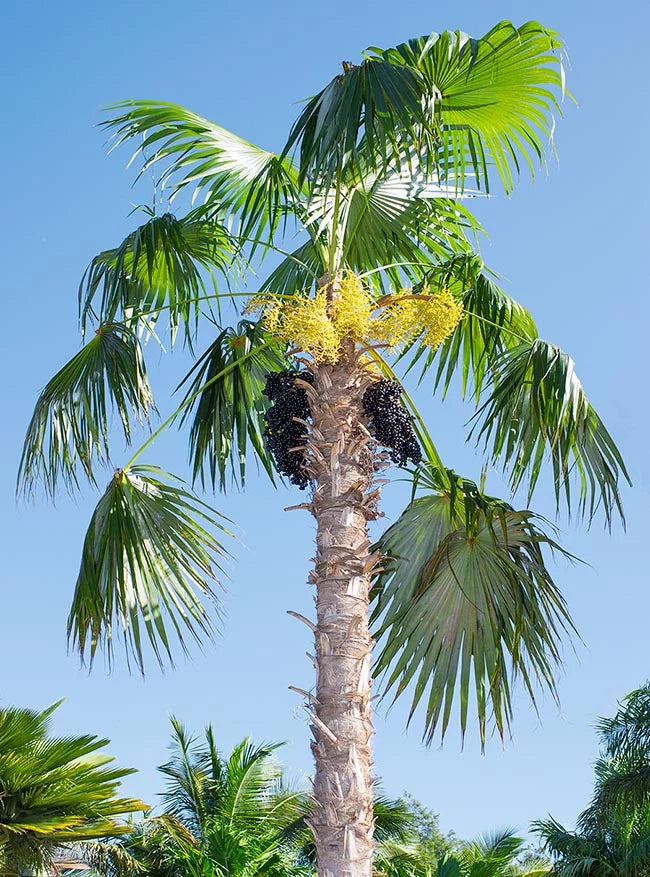
Coccothrinax barbadensis: A comprehensive Growing Guide for Enthusiasts & Collectors.
Coccothrinax barbadensis
This study provides a detailed guide to Coccothrinax barbadensis, covering its biology, cultivation, and care. It is designed to be a valuable resource for both novice palm growers and seasoned enthusiasts, offering foundational knowledge alongside advanced techniques.
1. Introduction
-
Habitat and Distribution, Native Continent: Coccothrinax barbadensis is native to the Lesser Antilles in the Caribbean, including islands such as Barbados, Martinique, Antigua, and Guadeloupe. Its natural habitat consists of coastal thickets, dry scrublands, and hillsides, often in limestone-based, alkaline soils. It is exceptionally well-adapted to environments with high winds, salt spray, and periods of drought. Its native continent is North America (specifically the Caribbean region).
BESTSELLER High Quality Tropical PlantLeucocasia Gigantea 'Thailand Giant'€25.59Get 10% OFF with code BLOG10Start Growing NowCOLD HARDY
 Fresh Seeds & High GerminationRhapidophyllum hystrix (Needle Palm)€9.99Get 10% OFF with code BLOG10Start Growing NowEXOTIC
 Elite Palm SelectionHyophorbe lagenicaulis (Bottle Palm)€24.90Get 10% OFF with code BLOG10Start Growing Now
 -
Taxonomic Classification and Species of this Palm Trees, Scientific Classification: The taxonomy of the Coccothrinax genus is notoriously complex and has been subject to much revision.
-
Kingdom: Plantae
-
Clade: Tracheophytes
-
Clade: Angiosperms
-
Clade: Monocots
-
Order: Arecales
-
Family: Arecaceae
-
Subfamily: Coryphoideae
-
Tribe: Cryosophileae
-
Genus: Coccothrinax
-
Species: C. barbadensis
-
-
Synonyms: Due to taxonomic debates, this species has been known by several names, which are now considered synonyms. The most common synonym is Coccothrinax alta. Others may include Thrinax barbadensis and Coccothrinax dussiana.
-
Common Names: It is widely known as the Barbados Silver Palm, Silver Thatch Palm, or simply Silver Palm. The name "Silver Palm" is derived from the striking, silvery-white tomentum (a layer of fine hairs) on the underside of its leaves, which flashes brilliantly in the wind. In French-speaking islands, it may be called "Latanier."
-
Expansion of this Palm Trees in the World: Due to its elegant appearance, moderate size, and remarkable toughness, Coccothrinax barbadensis has become a popular ornamental palm in tropical and subtropical regions worldwide. It is extensively cultivated in Florida, California, Hawaii, Australia, and across Southeast Asia and the Mediterranean coast, prized for its use in coastal landscapes, streetscaping, and as a container specimen.
2. Biology and Physiology
-
Morphology (Trunk, Leaves, Flower Systems):
-
Trunk: It features a solitary, slender trunk that can reach heights of 2 to 10 meters (6-33 ft). The trunk is typically 10-20 cm (4-8 inches) in diameter and is covered in a dense, woven mat of brown fibers, particularly in its younger years. On older specimens, the lower trunk may become smooth and grey.
-
Leaves: The leaves are palmate (fan-shaped), about 1 meter (3 ft) in diameter, and are a key ornamental feature. The upper surface is typically light to dark green, while the lower surface is covered in a conspicuous silvery-white layer. The leaf is split about halfway into numerous rigid, pointed segments.
-
Flower Systems: The palm is monoecious, meaning individual palms have both male and female flowers. The inflorescence is branched and emerges from among the leaves, extending beyond them. It bears small, yellowish, fragrant flowers. Following pollination, these develop into small, spherical fruits that transition from green to a deep purplish-black when ripe, each containing a single seed.
-
-
Life Cycle of Palm Trees: Coccothrinax barbadensis is a slow-growing, long-lived perennial. The life cycle begins with seed germination, which can be slow and erratic. The seedling stage is characterized by very slow growth, followed by a juvenile phase where the trunk begins to form. Maturity is reached when the palm begins to flower and produce fruit, a process that can take many years.
-
Specific Adaptation to Different Climate Conditions: This palm's biology is a masterclass in adaptation. Its deep root system seeks out water during dry spells, making it highly drought-tolerant once established. The fibrous trunk provides insulation and protection. The tough, waxy leaf cuticle and silvery underside reduce water loss (transpiration) and reflect intense solar radiation, making it perfectly suited for hot, sunny, and windy coastal climates. It is also highly tolerant of saline soils and salt spray.
3. Reproduction and Propagation
Seed Reproduction
-
Seed Morphology and Diversity: The seeds are small, spherical, and about 6-8 mm in diameter. When mature, the fruit's thin pulp covers a hard, black seed. There is little morphological diversity within the species.
-
Detailed Seed Collection and Viability Testing: Collect seeds from fully ripe, purplish-black fruits. Clean off all pulp immediately, as it contains germination inhibitors. To test for viability, place the cleaned seeds in a container of water; viable seeds will typically sink, while non-viable ones will float. Freshness is paramount for high germination rates.
-
Pre-germination Treatments:
-
Soaking: This is the most important treatment. Soak the cleaned seeds in warm water for 2-3 days, changing the water daily to leach out any remaining chemical inhibitors.
-
Scarification/Heat Treatments: These methods are generally unnecessary and not recommended for Coccothrinax barbadensis. The seed coat is permeable enough after soaking.
-
-
Step-by-step Germination Techniques:
-
Prepare a well-draining germination medium, such as a 50/50 mix of peat moss and perlite or sand.
-
Plant the soaked seeds shallowly, about 1 cm (0.5 inches) deep.
-
Moisten the medium so it is damp but not waterlogged.
-
Place the pot or container in a warm location. High, consistent heat is the key to success. Maintain a temperature between 29-35°C (85-95°F). A heat mat is highly recommended.
-
Cover the container with a plastic lid or place it inside a plastic bag to maintain high humidity.
-
-
Germination Difficulty: Germination is considered moderately difficult due to its slowness and erratic nature. Patience is essential.
-
Germination Time: Germination can take anywhere from 2 to 6 months, with some seeds taking up to a year or more to sprout.
-
Seedling Care and Early Development Stages: Once a seedling sprouts, provide bright, indirect light. Maintain warmth and consistent moisture. Growth is very slow initially; a seedling may only produce one or two leaves in its first year. Do not over-fertilize at this stage.
Advanced Germination Techniques
-
Hormonal Treatments: For very stubborn batches of seeds, advanced growers can experiment with a brief soak in a solution of Gibberellic Acid (GA3). This plant hormone can help break dormancy and promote more uniform germination, but it should be used with caution and according to precise instructions.
4. Cultivation Requirements
-
Light Requirements: Coccothrinax barbadensis is a full-sun palm. While young seedlings and juvenile palms can benefit from some partial shade to prevent scorching, established palms thrive and look their best in direct, all-day sun. For indoor cultivation, provide the brightest possible location, such as a south-facing window.
-
Temperature and Humidity Management:
-
Optimal Temperature: It thrives in warm climates with temperatures between 20-35°C (70-95°F).
-
Cold Tolerance: It is cold-hardy down to approximately -2°C (28°F) for very brief periods, but foliage damage will occur. It is best suited for USDA Hardiness Zones 10a-11.
-
Humidity: It is adaptable to a wide range of humidity levels, from dry to humid, thanks to its coastal origins.
-
-
Soil and Nutrition:
-
Ideal Soil: Excellent drainage is non-negotiable. It prefers sandy, well-aerated soils and is highly tolerant of alkaline (high pH) conditions. For potting, use a mix designed for cacti/palms, or create your own with potting soil, sand, and perlite/pumice.
-
Nutrient Requirements: It is not a heavy feeder. In the landscape, 1-2 applications of a balanced, slow-release palm fertilizer during the growing season is sufficient. In pots, fertilize more frequently (e.g., every 2-3 months) at half-strength during spring and summer.
-
Micronutrient Deficiencies: Like many palms, it can be susceptible to potassium (K) and magnesium (Mg) deficiencies in poor soils, which manifest as frizzling or yellowing on older fronds. Use a fertilizer formulated specifically for palms to prevent this.
-
-
Water Management:
-
Irrigation: Water newly planted palms regularly to establish a deep root system. Once established, it is highly drought-tolerant. Water thoroughly, then allow the top several inches of soil to dry out completely before watering again.
-
Water Quality: It is tolerant of various water qualities, including moderately saline water.
-
Drainage: Avoid waterlogged conditions at all costs, as this will lead to fatal root rot.
-
5. Diseases and Pests
-
Common Problems: This is a remarkably pest- and disease-resistant palm. Most problems arise from incorrect cultivation, primarily overwatering.
-
Identification of Diseases and Pests:
-
Pests: Scale insects and mealybugs are the most common pests, especially on indoor or stressed plants. They appear as small bumps or cottony masses on the fronds.
-
Diseases: The primary disease concern is root rot, caused by soggy soil. Fungal leaf spots can occur in conditions of poor air circulation and high humidity but are rarely serious.
-
-
Environmental and Chemical Protection Methods:
-
Environmental: Ensure excellent drainage and air circulation. Water correctly.
-
Chemical: For pests, treat with horticultural oil or insecticidal soap. Avoid harsh chemical pesticides that can harm the plant and beneficial insects.
-
6. Indoor Palm Growing
-
Specific Care in Housing Conditions: Its slow growth and moderate size make it a good candidate for long-term container cultivation. Place it in the sunniest spot in your home. Rotate the pot quarterly to ensure even growth. Be vigilant about not overwatering, as this is the most common mistake for indoor palms.
-
Replanting and Wintering: Repot only when the palm is severely root-bound (e.g., every 3-5 years), as it dislikes root disturbance. Use a deep pot to accommodate its root system. During winter, reduce watering frequency as growth slows. Keep it away from cold drafts and direct heat from vents.
7. Landscape and Outdoor Cultivation
Establishment and Maintenance in Landscapes
-
Planting Techniques for Success: Select a location in full sun with well-draining soil. Dig a hole twice as wide as the root ball but no deeper. Place the palm in the hole, ensuring the base of the trunk is at or slightly above soil level. Backfill with the native soil and water thoroughly to settle the soil around the roots.
-
Long-term Maintenance Schedules: Coccothrinax barbadensis is a very low-maintenance landscape palm.
-
Pruning: It is partially self-cleaning, meaning old fronds will eventually drop on their own. However, for aesthetic reasons, dead fronds can be pruned off. Only remove fully brown fronds; never cut green or partially yellow ones.
-
Fertilizing: Apply a palm-specific fertilizer once or twice during the growing season.
-
Watering: After the first year of establishment, it typically requires no supplemental irrigation except in periods of extreme, prolonged drought.
-
8. Cold Climate Cultivation Strategies
-
Cold Hardiness: As a Zone 10a palm, it is not suited for true cold climates. Its absolute limit for survival is a brief dip to around -2°C (28°F).
-
Winter Protection: In marginal zones (e.g., 9b), success is possible with protection. Plant it in a protected microclimate, such as against a south-facing wall that radiates heat.
-
Hardiness Zone: USDA Zones 10a to 11.
-
Winter Protection Systems and Materials: For freezes, protect the palm by wrapping the trunk with burlap or blankets. For younger palms, the entire plant can be covered with a frost cloth. Heavily mulching the root zone provides insulation. Some growers use incandescent Christmas lights wrapped around the trunk and heart for a small amount of heat.
Final Short Summary
Coccothrinax barbadensis, the Barbados Silver Palm, is an exceptionally elegant and resilient fan palm celebrated for the stunning silver undersides of its leaves. Native to the Caribbean, it is highly adapted to heat, drought, wind, and salt spray, making it a premier choice for challenging coastal and subtropical landscapes. While its growth is slow and germination requires patience and heat, its low maintenance needs, pest resistance, and suitability for both outdoor landscapes and indoor containers make it a rewarding and durable palm for growers of all experience levels. Its key requirements are full sun, excellent drainage, and protection from hard freezes.