Hesperocallis undulata (Desert Lily)
Hesperocallis undulata (Desert Lily)


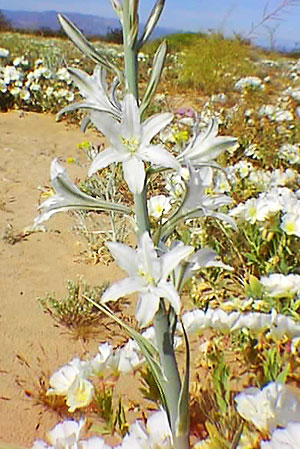
Table of Contents
- Introduction
- Identification Guide
- Taxonomy & Classification
- Bloom & Pollinators
- Similar Species
- Native Range & Habitat
- Growing from Seed
- Garden Cultivation
- Companion Planting
- Wildlife Value
- Conservation
- Seasonal Interest
- Landscape Design
- Varieties & Cultivars
- Folklore & Ethnobotany
- Beginner's Guide
- FAQ
🌻 Introduction
Hesperocallis undulata is a bulbous perennial of the Asparagaceae family, the sole species in its genus, endemic to the Sonoran and Mojave deserts of Arizona, California, and Baja California. Plants emerge after winter rains, producing a rosette of wavy-edged blue-green leaves and a stout flower stalk 30-180 cm tall bearing fragrant, white funnel-shaped flowers 5-7 cm across with green-striped exteriors. It thrives in USDA zones 8-11 on deep sandy soils and blooms only in years with adequate winter precipitation.
The bulb is deeply buried 30-60 cm below the surface, ovoid, 5-8 cm in diameter, with brown papery tunics. Leaves are 5-12 in a basal rosette, linear, 15-40 cm long, with distinctive undulate (wavy) margins that give the species its name. The flower stalk is stout, erect, and bears a terminal raceme of 8-30 flowers. Each flower has 6 tepals, white on the inner surface and green-striped on the reverse, fused at the base into a funnel 5-7 cm long. The fragrance is strong, sweet, and most intense at dusk.
Quick Facts
| Common Name | Desert Lily |
| Family | Asparagaceae |
| Order | Asparagales |
| Group | Desert Wildflowers |
| Origin | North America |
| Bloom Season | Early spring |
| Height | 30-180 cm |
| Conservation | Least Concern |
🔍 Identification Guide
Unmistakable when in flower: the tall stalk of large white flowers rising from desert sand is unique in the North American flora. The wavy-edged leaves are diagnostic even without flowers. Pancratium maritimum (sea daffodil) is a Mediterranean species with similar flowers but grows on coastal sand and has a corona cup. When dormant, the deeply buried bulb makes the plant effectively invisible at the surface.
Flower Anatomy
| Feature | Description |
|---|---|
| Bloom Color | White |
| Flower Shape | Funnel-shaped with six tepals, green-striped exterior |
| Flower Size | 5-7 cm |
| Leaf Type | Linear, undulate-margined, basal, blue-green |
| Leaf Arrangement | Basal rosette |
| Growth Habit | Erect from deep bulb |
| Root Type | Deep bulb (30-60 cm underground) |
Field Identification Checklist
- Flower shape: Funnel-shaped with six tepals, green-striped exterior
- Bloom color: White
- Leaf type: Linear, undulate-margined, basal, blue-green
- Leaf arrangement: Basal rosette
- Growth habit: Erect from deep bulb
- Height: 30-180 cm
- Root system: Deep bulb (30-60 cm underground)
- Fragrant flowers
Detailed Morphology
Tepals are 40-60 mm long, the outer 3 broader with a prominent green midstripe, the inner 3 narrower and pure white. Stamens 6, filaments attached at the tepal base, anthers versatile and medifixed. The ovary is superior, trilocular, with 8-12 ovules per locule. The fruit is a loculicidal capsule, 15-25 mm, producing flat, black seeds 6-8 mm across. The deeply buried bulb represents an extreme adaptation to desert heat and aridity.
🧬 Taxonomy & Classification
Hesperocallis is a monotypic genus, with H. undulata as the sole species. Formerly placed in Liliaceae, it was moved to Asparagaceae (subfamily Agavoideae) based on molecular phylogenetics. Its closest relatives are Hosta and Agave, though it shares few morphological similarities with either. The genus name means 'western beauty' (Greek hesperos + kallos). Chromosome number is 2n=24.
🐝 Bloom & Pollinators
Flowering is strictly dependent on winter rainfall exceeding approximately 75 mm; in drought years, plants remain dormant underground and may not emerge for several consecutive seasons. When conditions are met, leaves appear in January-February and flowers open in March-April. Each flower lasts 2-3 days, opening in late afternoon and remaining open through the night to attract crepuscular and nocturnal pollinators. Entire populations bloom synchronously within a 2-3 week window.
Pollinator Relationships
White-lined sphinx moths (Hyles lineata) are the primary pollinators, attracted by the white colour, strong evening fragrance, and nectar produced at the base of the long floral tube. Large solitary bees visit the flowers during the day. The nocturnal pollination syndrome (white colour, strong scent, dusk opening) is classic sphingophily. Nectar sugar concentration averages 15-25%, dilute relative to bee-pollinated flowers, as typical for moth pollination.
Bloom Details
| Bloom Season | Early spring |
| Bloom Colors | White |
| Flower Size | 5-7 cm |
| Fragrant | Yes |
🔎 Similar Species
No close look-alikes exist in its native range; the combination of wavy-edged leaves, deeply buried bulb, and large white fragrant flowers is unique. Pancratium maritimum (sea daffodil) of the Mediterranean has superficially similar flowers but grows in coastal sand, has a staminal corona cup, and belongs to Amaryllidaceae. Hymenocallis species (spider lilies) have narrower tepals with a connecting membrane.
Known Look-Alikes
| Species | Group | Key Differences |
|---|---|---|
| Pancratium maritimum | Unknown | Compare all identifying features carefully |
🌍 Native Range & Habitat
Restricted to sandy desert flats, bajadas, and stabilised dunes in the Sonoran and western Mojave deserts, from western Arizona through the Coachella Valley and Imperial Valley to Baja California. It grows in deep aeolian or alluvial sand at elevations below 700 m, where the 30-60 cm bulb depth provides thermal buffering from surface temperatures that can exceed 70 degrees Celsius. Associated species include Larrea tridentata, Ambrosia dumosa, and Hilaria rigida.
Range & Habitat
| Native Range | Sonoran and Mojave Deserts — Arizona, California, Baja California |
| Habitat | Sandy desert flats, dunes, bajadas in Sonoran Desert |
| Invasive Status | Native Species |
| Conservation Status | Least Concern |
🌱 Growing from Seed
Sow fresh seed 1 cm deep in deep pots (30+ cm) filled with pure washed sand. Keep moist at 15-20 degrees Celsius; germination is slow and irregular, ranging from 4 weeks to 6 months. Seedlings produce grass-like leaves the first year and form a small bulb by year 2. Flowering from seed requires 5-8 years as the bulb must reach critical size (3+ cm diameter). This extended juvenile period makes vegetative propagation from offsets more practical for gardeners.
Propagation Methods
- Seed
- Bulb offsets
Seed Starting Guide
| Best Sowing Season | Autumn or early spring for most species |
| Germination | Sow fresh seed in sandy mix, germination slow and erratic |
🏡 Garden Cultivation
Plant bulbs 30-40 cm deep in pure sand or very sandy loam in full sun. Provide supplemental winter irrigation (50-100 mm over November-February) if winter rains are insufficient to trigger growth. Withhold all water from May through October to replicate the natural summer dormancy. In zones 8-9, plants succeed in raised beds with 50 cm of sand over a drainage layer. Not suitable for clay soils or summer-irrigated gardens.
Site Requirements
| Requirement | Details |
|---|---|
| Sun Exposure | Full sun |
| Soil Type | Sandy, Well-drained |
| Soil pH | Neutral to slightly alkaline |
| Moisture | Very low |
| USDA Zones | 8-11 |
🤝 Companion Planting
Plant with Larrea tridentata and Ambrosia dumosa for an authentic Sonoran Desert sand-flat community. The white flowers emerge above a carpet of Abronia villosa (sand verbena) and Oenothera deltoides (dune evening primrose) in wet springs. Combine with Penstemon parryi and Encelia farinosa on the margins of sandy areas. Avoid planting near irrigated landscape zones where summer water would rot the bulb.
Recommended Companion Plants
🦋 Wildlife Value
White-lined sphinx moths depend on the nectar during their spring emergence. Desert kangaroo rats and pocket mice excavate and eat the bulbs, representing significant herbivory pressure. The flowers provide nectar for early-emerging solitary bees. Ground squirrels consume the developing seed capsules. The ephemeral above-ground growth contributes organic matter to nutrient-poor desert sand ecosystems.
Wildlife Interactions
- Night-fragrant flowers attract hawkmoths
- Seeds eaten by rodents
| Deer Resistant | Yes — deer typically avoid this plant |
| Rabbit Resistant | Yes — rabbits typically avoid this plant |
🌿 Conservation
Listed as Least Concern overall, but local populations have been extirpated by housing development in the Coachella Valley and along the US-Mexico border. Protected under Arizona native plant law. Critical habitat for this species coincides with desert tortoise conservation areas. Climate models predict range contraction under warming scenarios as winter rainfall decreases. Seeds are not widely available commercially; most plants in cultivation are wild-collected bulbs.
📅 Seasonal Interest
Completely invisible above ground during the long summer-autumn dormancy (May-December). Leaves emerge after winter rains in January-February, forming an attractive blue-green rosette with wavy edges. Spectacular flowering occurs in March-April. Capsules ripen and scatter seeds by May, after which all above-ground parts wither. In drought years, the plant may remain dormant for 2-3 consecutive seasons.
🏨 Landscape Design
A specialty plant for collectors and desert purists, suitable only for deep-sand desert gardens with natural rainfall patterns. Plant in groups of 5-10 in undisturbed sandy areas away from irrigation systems. Combine with other desert ephemerals for a naturalistic spring wildflower display. Not suited to conventional garden beds, containers, or non-desert climates. Best appreciated in botanic garden desert exhibits.
Design Considerations
- Growth form (Erect from deep bulb) determines placement in borders and naturalistic plantings
- At 30-180 cm, consider position relative to sight lines and companion heights
- Allow 15-30 cm spacing for natural spread
- Low-maintenance choice for naturalistic or xeriscape plantings
🏷️ Varieties & Cultivars
No cultivars exist. Plants from the Mojave Desert tend to be shorter-stalked (30-60 cm) than Sonoran populations (to 180 cm). A pale yellow-flowered form has been reported from Baja California but is not in cultivation. All commercially available material is wild-type. Bulb offsets are occasionally offered by specialist desert plant nurseries, but supply is extremely limited.
📜 Folklore & Ethnobotany
The Cahuilla people roasted and ate the starchy bulbs, which reportedly taste similar to sweet potato when cooked. Multiple desert tribes used the saponin-rich bulb as a soap for washing hair and clothing. The Mohave called the plant 'aha kwi-nyee' and considered mass flowering a portent of good harvests. Early Spanish explorers called it 'ajo del desierto' (desert garlic) for the onion-like bulb.
Traditional & Ethnobotanical Uses
- Cahuilla ate roasted bulbs
- Bulb used as soap by indigenous peoples
Medicinal & Herbal Uses
Indigenous peoples used the bulb primarily as food rather than medicine, though the saponin content may have had mild antimicrobial properties in wound-washing applications. The bulb contains steroidal saponins similar to those in Agave and Yucca. No modern medicinal use exists. The raw bulb is mildly irritating to skin and must be cooked before consumption to break down saponins.
💡 Beginner's Guide
This is an advanced plant for experienced desert gardeners only; beginners should start with Baileya or Sphaeralcea instead. If attempting it, plant bulbs at least 30 cm deep in pure sand with no organic matter. Provide one deep winter soaking in December and one in February, then no water for the rest of the year. Be patient: the plant may not emerge every year, and flowering from a new bulb may take 3-5 years.
Common Mistakes to Avoid
Most desert species rot in consistently moist soil; water deeply but infrequently, mimicking natural rainfall patterns
Desert annuals need precise temperature and moisture triggers; sow cool-season species in autumn and warm-season species after spring rains
Most desert wildflowers need full, intense sun; shade causes etiolation and reduces flowering
Growing Tips
Troubleshooting
Bulb rot from summer irrigation is the most common cause of failure; ensure zero water reaches the bulb from May through November. Failure to emerge in spring usually indicates insufficient winter rainfall; provide a deep soaking equivalent to 50 mm of rain. Pocket gophers and kangaroo rats dig up and eat the bulbs; use hardware cloth baskets around planted bulbs. Seed germination is very slow; do not discard pots for at least 12 months.
Quick Start Checklist
- Provide full sun conditions
- Use sandy, well-drained soil
- Water: very low
- Propagate by: seed, bulb offsets
- Hardy in USDA zones 8-11
❓ Frequently Asked Questions
How do I grow Desert Lily from seed?
Hesperocallis undulata can be propagated from seed. Sow fresh seed in sandy mix, germination slow and erratic
When does Desert Lily bloom?
Hesperocallis undulata blooms early spring, producing flowers in white.
Is Desert Lily deer resistant?
Yes, Hesperocallis undulata is considered deer resistant. Deer typically avoid this plant, making it a good choice for gardens in areas with high deer pressure.
What pollinators does Desert Lily attract?
Hesperocallis undulata attracts hawkmoths, bees. It is a valuable nectar and pollen source for these species.
What are the best companion plants for Desert Lily?
Good companion plants for Hesperocallis undulata include Larrea tridentata, Ambrosia dumosa. These species share similar growing requirements and complement each other ecologically.
Is Desert Lily invasive?
No, Hesperocallis undulata is a native species and is not considered invasive. It is well-adapted to its natural range and supports local ecosystems.
What USDA zones is Desert Lily hardy in?
Hesperocallis undulata is hardy in USDA zones 8 to 11. It may survive outside this range with appropriate microclimate management or winter protection.
How tall does Desert Lily grow?
Hesperocallis undulata typically reaches 30-180 cm in height. Actual size may vary depending on growing conditions, soil quality, and climate.
What soil conditions does Desert Lily prefer?
Hesperocallis undulata prefers sandy, well-drained with neutral to slightly alkaline pH soil. Good drainage is important for most wildflower species.
What are similar species to Desert Lily?
Species that may be confused with Hesperocallis undulata include Pancratium maritimum. Careful comparison of flower shape, leaf structure, and habitat can help distinguish between them.
📋 Summary — Hesperocallis undulata (Desert Lily)
Hesperocallis undulata is a bulbous perennial of the Asparagaceae family, the sole species in its genus, endemic to the Sonoran and Mojave deserts of Arizona, California, and Baja California. Plants emerge after winter rains, producing a rosette of wavy-edged blue-green leaves and a stout flower stalk 30-180 cm tall bearing fragrant, white funnel-shaped flowers 5-7 cm across with green-striped exteriors. It thrives in USDA zones 8-11 on deep sandy soils and blooms only in years with adequate winter precipitation.
Quick Reference
| Family | Asparagaceae |
| Bloom Season | Early spring |
| Height | 30-180 cm |
| Sun | Full sun |
| USDA Zones | 8-11 |
| Deer Resistant | Yes |
| Drought Tolerant | Yes |
Bonsai · Houseplants · Mushrooms · Herbs · Vegetables · Roses · Ferns · Climbing Plants · Aquatic Plants