Curcuma longa (Turmeric)
Curcuma longa (Turmeric)


Contents
Introduction & History
Turmeric is the golden thread that runs through Indian civilisation — it colours the bride's face, stains the monk's robe, flavours the evening dal, and soothes the grandmother's aching joints. The rhizome's deep orange-gold colour comes from curcumin, a polyphenol that has launched more scientific studies than almost any other plant compound. In the garden, turmeric is ginger's flashier cousin — same growth habit, but with dramatic canna-like foliage and, if you're lucky, a stunning torch-shaped flower in pink and white.
History & Origin
Native to the Indian subcontinent and mainland Southeast Asia. Domesticated over 4,000 years ago — turmeric appears in the oldest Vedic texts. Traded across the Indian Ocean to China and Africa since antiquity. Marco Polo encountered it in 1280 and described it as 'a plant with the properties of saffron.' India produces 80% of the world's turmeric, consuming most of it domestically.
Botanical Description
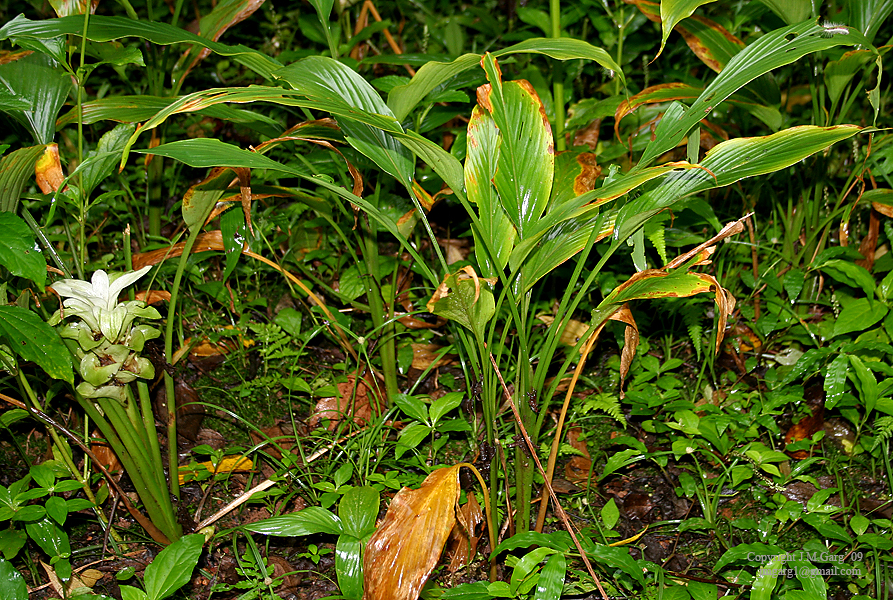
Herbaceous perennial, 60–100 cm tall, growing from a thick, intensely orange rhizome. The pseudostems bear large, oblong-lanceolate leaves 30–50 cm long, broader and more paddle-shaped than ginger. The flower spike, when produced, rises from the centre of the leaf clump — a cone-shaped bract structure in green shading to pink-white at the tips, with small, pale yellow tubular flowers peeking from between the bracts. Flowering is uncommon outside the tropics.
Stem: Semi-woody to woody at base • Height: 100 cm at maturity • Spread: 60 cm • Foliage: large green • Flowers: white-pink (summer)
Planting & Cultivation
Identical to ginger: plant fresh rhizome pieces with 2–3 buds, 5–7 cm deep, in spring after soil warms above 20 °C. Space 30 cm apart. Rich, moist, well-drained, slightly acidic soil. Part shade mimics the forest understorey. In temperate zones, start indoors in late winter in warm conditions and transplant after the last frost.
| Sun exposure | Partial Shade |
| Soil pH | 5.5-7.0 |
| Spacing | 60 cm |
| Seed depth | 3–6 mm (surface-sow if light-dependent germinator) |
| Water needs | High |
| Soil type | Well-drained, humus-rich loam; add perlite or grit for drainage |
Cultivation Details
Requires slightly more heat and a longer season than ginger — 9–10 months for full rhizome development. Keep consistently moist (mulch heavily) and feed fortnightly with a balanced fertiliser. The large leaves photosynthesize energetically; shade from intense midday sun but provide bright morning light. Dormancy begins when night temperatures drop below 15 °C — foliage yellows and dies back.
Climate & Hardiness
Tropical perennial in zones 8–12. Needs 9–10 months of warm weather. In zones 7–8, treat as a warm-season container crop — start early indoors for the best yield. Dormant rhizomes survive brief cold to −5 °C under heavy mulch, but the tops are killed by any frost. Optimum growing temperature 25–30 °C. Below 15 °C, growth stalls completely.
USDA zones: 9-11
Minimum temperature: 5°C
Indoor growing: Suitable for windowsill culture with 6+ hours light
Seasonal Care
Late winter: plant rhizome pieces indoors in warm, moist compost. Spring: shoots emerge; move outdoors after last frost. Summer: lush growth — water heavily, feed fortnightly, mulch. Autumn: foliage dies back — reduce watering. Harvest after tops have died. Winter: cure and store harvested rhizomes; or leave dormant rhizomes in the ground under thick mulch (zones 8+).
Propagation
By rhizome division only — identical to ginger. Fresh organic turmeric from health food stores works well. Choose rhizomes with visible buds; let cut surfaces dry for a day. Plant 5–7 cm deep in warm compost. Each piece yields a clump of rhizomes that can be divided again next year. Turmeric does not produce viable seed outside its native range.
| Method | Success rate | Time | Notes |
|---|---|---|---|
| Stem cuttings | 70–90% | 2—4 weeks | Softwood in spring, semi-ripe in summer; 8–12 cm |
| Division | 95%+ | Immediate | Split established clumps in spring or autumn |
| Seed | 50–80% | 14–28 days | Some require cold stratification; germination variable |
| Layering | 80–90% | 6–12 weeks | Pin low branch to soil; sever when rooted |
🌍 Distribution Map
Native origin: India, Southeast Asia
Diseases & Pests
Rhizome rot (Pythium, Fusarium) in waterlogged soil is the biggest threat. Shoot borer (Conogethes punctiferalis) tunnels into pseudostems in tropical regions. Leaf spot and leaf blotch in humid conditions — improve airflow. Root-knot nematodes in tropical soils. In temperate container cultivation, problems are rare; occasional aphids or spider mites can be managed easily.
Culinary Uses
Essential in Indian, Thai, and Indonesian cuisine — the base of virtually every curry paste and powder. Fresh turmeric has a brighter, more peppery flavour than dried. Grate into golden milk (turmeric latte with warm milk and spices). Add to rice, scrambled eggs, smoothies, soups, and pickles. Turmeric paste is the starting point for rendang, massaman, and yellow curry. In Okinawan cuisine, fresh turmeric is grated into tea for longevity.
Medicinal & Aromatherapy
Curcumin is one of the most-researched natural compounds — over 15,000 published studies. Anti-inflammatory and antioxidant properties are well-documented. Clinical evidence supports benefits for osteoarthritis pain, metabolic syndrome markers, and post-exercise recovery. Curcumin is poorly absorbed alone — consume with black pepper (piperine) and fat to enhance bioavailability. Traditional Ayurvedic uses: wound healing, digestive support, liver tonic. Safe in culinary doses; high-dose supplements may interact with blood thinners.
Container & Companion Growing
Container Growing
Very rewarding in large containers (40+ L). Use rich, slightly acidic potting mix. Part shade outdoors, bright window indoors. Water generously during growth. The foliage is handsome — large, canna-like leaves create a tropical look on a patio. A single rhizome can produce 200–500 g of fresh turmeric by harvest time.
• Minimum pot size: 20–25 cm Ø, 5 L+
• Warmth-loving; consider windowsill in winter
• Use free-draining potting compost with 20–30% perlite or grit
• Ensure drainage holes; stand on pot feet to prevent waterlogging
• Feed with dilute liquid fertiliser (half-strength) every 2–3 weeks in growing season
• Indoor: Place on brightest windowsill (south-facing ideal); supplement with grow lights in winter
Companion Planting
Excellent with ginger, galangal, and lemongrass — they share identical growing requirements. Plant under the canopy of taller crops: beans, corn, bananas. In South Indian tradition, turmeric is grown as an intercrop in coconut plantations. The broad leaves create ground-level shade that suppresses weeds.
| ✓ Good companions | Eggplant, Peppers, Beans |
| ✗ Avoid planting with | Fennel, Dill (cross-pollinates) |
Common Mistakes to Avoid
Not allowing enough time — turmeric needs 9–10 months of warmth. Underwatering (the plant is a tropical moisture-lover). Not wearing gloves when handling fresh turmeric (it stains skin and surfaces bright yellow for days). Planting in full sun without shade. Harvesting too early, getting tiny, undeveloped rhizomes.
Harvesting & Preservation
Harvest 9–10 months after planting, when foliage has completely died back. Dig the entire clump carefully. Fresh turmeric stores in the fridge for 2–3 weeks or can be frozen whole. For dried turmeric: boil rhizomes for 30–45 minutes, sun-dry for 10–15 days, then grind. Fresh turmeric is more aromatic and staining than dried. Warning: turmeric stains everything it touches — wear gloves.
• Time of day: Early morning, after dew has evaporated but before intense midday heat volatilises essential oils
• Growth stage: Just before flowering, when essential oil concentration peaks. Once flowers open, the plant redirects energy from leaf production
• Season: Autumn-Winter (8-10 Months)
• Part harvested: Rhizomes
• Harvest rule: Never remove more than ⅓ of the plant at once; this ensures continued vigorous regrowth
• Technique: Cut stems cleanly above a leaf node with sharp scissors or secateurs. Tearing damages tissue and invites disease
| Method | Process | Shelf life | Best for |
|---|---|---|---|
| Air drying | Tie bundles, hang upside down in warm, dark, airy space | 6–12 months | Most herbs |
| Oven / dehydrator | Spread on trays, 35–45°C until crisp | 6–12 months | Fleshy-leaved herbs |
| Freezing (whole) | Blanch 5s, ice bath, pat dry, freeze flat on tray | 6 months | Basil, chives, parsley |
| Freezing (oil cubes) | Chop fine, pack into ice cube tray, cover with olive oil | 6 months | Any culinary herb |
| Herb salt | Layer herb and coarse salt 1:4, dry and grind | 12+ months | Rosemary, thyme, sage |
| Infused vinegar | Pack jar, cover with warm vinegar, steep 2–4 weeks | 6 months | Tarragon, dill, basil |
| Infused oil | Fill jar with dried herb, cover with oil, steep 4–6 weeks | 3–6 months | Rosemary, thyme, chilli |
Frequently Asked Questions
Can I grow turmeric from store-bought rhizomes?
Yes — choose organic, fresh rhizomes with visible buds from a health food store. Plant exactly like ginger. Conventional turmeric may have been treated with growth inhibitor.
How do I make turmeric powder at home?
Boil fresh rhizomes for 30–45 minutes, then sun-dry (or dehydrate at 60 °C) for several days until rock-hard. Grind in a powerful blender or spice grinder. The aroma far exceeds commercial powder.
Does homegrown turmeric have more curcumin?
Fresh turmeric contains curcuminoids just as commercial turmeric does. The advantage of homegrown is freshness — the volatile aromatic compounds that give fresh turmeric its distinctive peppery, gingery punch are lost in dried, shipped rhizomes.
Seasonal Care Calendar
🌱 Spring (Mar–May)
Water: Regular
Feeding: Regular feeding
☀️ Summer (Jun–Aug)
Water: Very Heavy
Feeding: Heavy feeding
🍂 Autumn (Sep–Nov)
Water: Moderate
Feeding: Light feeding
❄️ Winter (Dec–Feb)
Water: Light
Feeding: No feeding
The golden rhizome of Indian cuisine — 4,000 years of culinary and medicinal use backed by 15,000 modern studies. Grow like ginger but allow a longer season. Fresh homegrown turmeric has a peppery brightness that dried powder can't match. Wear gloves.
Quick Reference: Curcuma longa
Key Principles: Right location, well-drained soil, regular harvesting to promote growth, and appropriate winter protection for tender species.