Juncus capensis: Complete Grass Growing Guide
Juncus capensis
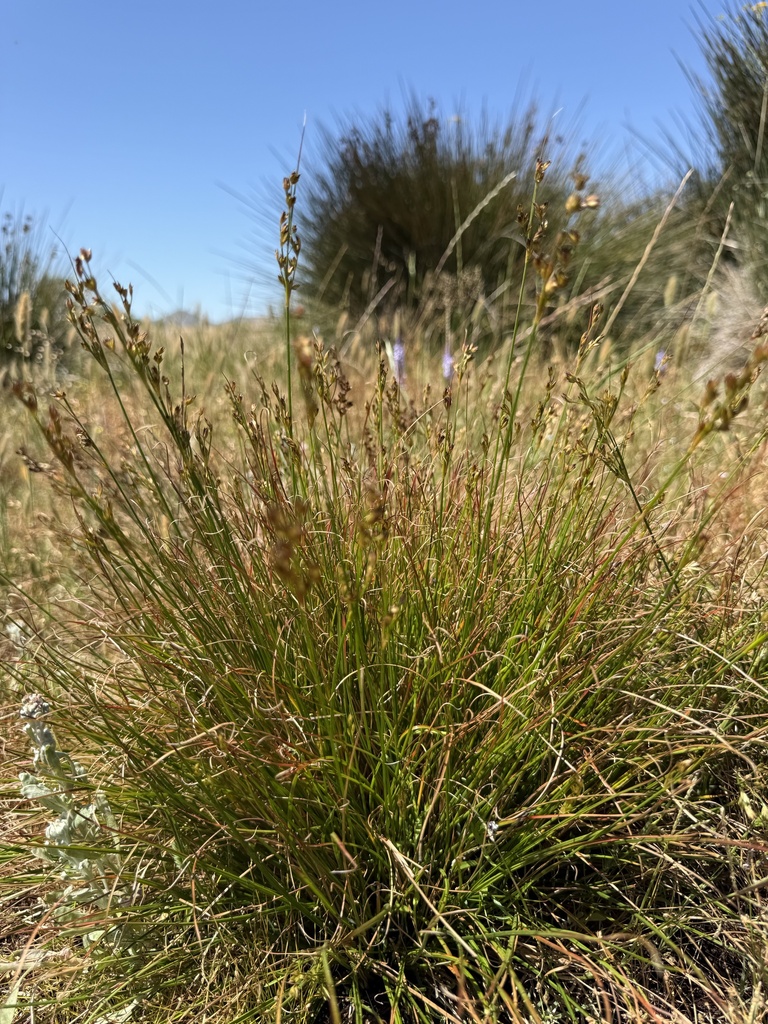
Juncus capensis (Source: inaturalist)
1. Introduction & Taxonomy
Juncus capensis, the Cape rush, is an elegant component of South Africa's Cape Floristic Region, where it inhabits the margins of streams, vleis, and seepages across the fynbos landscape. With its slender, dark green stems forming graceful tussocks, this rush occupies a quiet but essential niche in one of the world's most botanically diverse ecosystems. Though often overlooked in favor of the showy proteas and ericas that share its homeland, Juncus capensis plays a vital role in stabilizing waterway banks and filtering water in this fire-prone Mediterranean-climate landscape.
Juncus capensis is a tufted perennial rush that forms dense clumps 40 to 80 centimeters tall, producing numerous slender, terete (round), dark green to olive-green stems from a compact rootstock. The stems are erect to slightly arching, smooth, and finely ridged longitudinally. The leaves are reduced to basal sheaths, with the photosynthetic stems serving as the primary foliage. The inflorescence is a compact to somewhat open, lateral cluster of small, brownish flowers and capsules that appears to emerge from the side of the stem, with the terminal bract continuing beyond it. The individual flowers are small, 3 to 4 millimeters long, with brown tepals and prominent stamens. The overall appearance is tidy and architectural, forming neat, dark green fountains of stems.
Taxonomic Classification
Habitat and Distribution
Juncus capensis is native to the Western Cape and parts of the Eastern Cape in South Africa, where it grows along streams, around vleis (shallow seasonal lakes), and in moist depressions within fynbos vegetation. It occurs from near sea level to moderate elevations in areas receiving winter-dominant rainfall.
Botanical Note: Juncaceae (the rush family) contains about 460 species, mostly in the genus Juncus. Rushes have round, solid stems and small, wind-pollinated flowers in clusters. The mnemonic 'rushes are round' helps distinguish them from sedges and grasses. Many Juncus species are valuable for wetland restoration, rain gardens, and erosion control in moist soils.
Native Range & Distribution Map
The map below shows the native range and notable cultivation regions for Juncus capensis.
2. Biology & Morphology
<\!-- SIZE_COMPARISON_SVG -->Growth Form & Architecture
Juncus capensis is a member of the rush family (Juncaceae), recognized by round, solid stems (the mnemonic 'rushes are round') and small, wind-pollinated flowers.
Species-Specific Morphology
Juncus capensis is a tufted perennial rush that forms dense clumps 40 to 80 centimeters tall, producing numerous slender, terete (round), dark green to olive-green stems from a compact rootstock. The stems are erect to slightly arching, smooth, and finely ridged longitudinally. The leaves are reduced to basal sheaths, with the photosynthetic stems serving as the primary foliage. The inflorescence is a compact to somewhat open, lateral cluster of small, brownish flowers and capsules that appears to emerge from the side of the stem, with the terminal bract continuing beyond it. The individual flowers are small, 3 to 4 millimeters long, with brown tepals and prominent stamens. The overall appearance is tidy and architectural, forming neat, dark green fountains of stems.
Inflorescence & Flower Structure
The inflorescence structure varies across grass-related families.
Key Characteristics
- Height: 0.5-2m
- Growth Habit: Clumping / Caespitose
- Growth Rate: Moderate under optimal conditions
- Life Cycle: Perennial
- Toxicity: Non-toxic. Juncus capensis poses no known chemical toxicity risk to humans, pets, or livestock. The stems are not sharp enough to cause physical injury, unlike some other rush species.
- Conservation Status: Least Concern. Juncus capensis is relatively widespread within its range and is not considered threatened, though some local populations have been affected by urban development, agricultural drainage, and invasion by alien plant species.
3. Reproduction & Propagation
<\!-- PROPAGATION_METHODS_SVG -->Primary propagation methods for Juncus capensis: Seed or vegetative division.
Propagating Juncus capensis
Juncus capensis is propagated by seed or division. Sow fresh seed on the surface of moist, sandy soil and keep at 15 to 20 degrees Celsius with good light. Germination occurs in 3 to 6 weeks. Division of established clumps is straightforward in autumn or early spring; separate the outer portions of the tussock with roots attached and replant at the same depth in moist soil. Both methods produce plants that establish readily in appropriate conditions.
Vegetative Propagation
Propagated by clump division in spring or early summer.
Propagation Tip: Division of established clumps in spring gives the fastest results.
4. Cultivation Requirements
<\!-- CULTIVATION_SVG -->Soil / Substrate
Moist to wet soil, tolerating poor drainage. Naturally adapted to wetland conditions.
Watering
Moderate. Juncus capensis prefers moist to seasonally wet soils but tolerates moderate drought once established, reflecting its adaptation to the Mediterranean climate of the Western Cape. Provide regular moisture during the dry season in cultivation.
Light Requirements
Full sun to partial shade. Most ornamental grasses perform best in full sun with at least 6 hours of direct light daily.
Temperature
- Optimal Growth: 18-30°C (65-86°F)
- Minimum Tolerance: -12°C (10°F)
- USDA Hardiness: Zones 8-11
Fertilization
Apply a balanced slow-release fertilizer in spring. Most grasses are light feeders.
Common Cultivation Mistake: Over-watering and over-fertilizing promote weak, floppy growth. These plants prefer lean conditions.
Seasonal Care Calendar
Follow this season-by-season guide for optimal care timing throughout the year.
🌱 Spring (March–May)
New growth begins as temperatures warm. Apply a light application of slow-release fertilizer if growing in containers. Divide overcrowded clumps.
☀️ Summer (June–August)
In Mediterranean climates, this is the dry season. Provide supplemental water to maintain moisture, especially for newly planted specimens. The species tolerates some seasonal drought once established.
🍂 Fall (September–November)
Rains return in winter-rainfall areas. Reduce supplemental watering. Seeds can be collected from mature capsules.
❄️ Winter (December–February)
Peak rainy season in the Western Cape. Plants remain evergreen and may put on significant growth during the cooler, wetter months. No special care needed.
5. Diseases & Pests
Below are the most common pests and diseases affecting Juncus capensis and how to manage them.
Stem borer insects
Various moth larvae may bore into the stems, causing dieback of individual culms. Damage is usually minor and the tussock recovers readily through production of new stems.
Leaf spot fungi
Brown spots or streaks may develop on stems during prolonged wet periods. Rarely significant and typically resolves with improved air circulation.
Root-knot nematodes
May infest roots in sandy soils, causing reduced vigor. Healthy plants in appropriate conditions generally tolerate light infestations.
IPM: (1) Choose the right species for your conditions. (2) Maintain good air circulation. (3) Cut back dead foliage in late winter. (4) Most ornamental grasses are remarkably pest-free when well-sited.
6. Indoor Growing Guide
Juncus capensis can be grown in containers and brought indoors during winter in cold climates.
Container Selection
Use containers with adequate drainage holes. Self-watering pots work well for moisture-loving sedges and rushes.
Indoor Light
Place in the brightest available location. Most grasses need at least 4-6 hours of direct or bright indirect light.
Indoor Success Key: Bright direct light is the single most important factor for growing grasses indoors.
7. Landscape Use & Design
Juncus capensis is ideal for water gardens, rain gardens, and pond margins.
Design Applications
- Rain gardens and bioswales
- Stream bank and waterway stabilization
- Fynbos garden and Cape indigenous garden design
- Water-sensitive urban design plantings
- Constructed wetlands for water filtration
Companion Planting
These species pair well with Juncus capensis in garden settings:
- Prionium serratum
- Zantedeschia aethiopica
- Wachendorfia thyrsiflora
- Cliffortia strobilifera
- Elegia capensis
Design Principle: Ornamental grasses are at their most magical when backlit by low sun. Position where morning or evening light illuminates inflorescences from behind.
8. Cold Climate Strategies
Juncus capensis tolerates cold to USDA Zone 8. Winter protection or container culture may be needed in colder areas.
Hardiness Thresholds
- USDA Zones: 8-11
- Minimum Survival Temperature: -12°C (10°F)
Overwintering Options
- Leave in Place (hardy species): Cut back dead foliage in late winter. Apply 5-10 cm of mulch around the crown.
- Container Culture: Move potted plants to a frost-free location for winter.
- Mulching: Apply thick straw or bark mulch over the crown after the first hard frost.
Winter Survival Rule: Most grass losses occur from wet cold. Ensure excellent drainage through winter.
Winter Care Tip: Peak rainy season in the Western Cape. Plants remain evergreen and may put on significant growth during the cooler, wetter months. No special care needed.
9. Ethnobotany & Cultural Significance
In the Cape region of South Africa, rushes including Juncus capensis have been used by indigenous Khoisan peoples and later by Cape Malay and settler communities for weaving baskets, mats, and thatching material. The species is an integral component of the riparian vegetation in the fynbos biome, where it contributes to water quality and stream bank stability. With growing interest in water-sensitive urban design in South African cities, Juncus capensis is increasingly specified for rain gardens, bioswales, and constructed wetlands in the Western Cape.
Conservation Note: Many grass, sedge, and rush species play critical ecological roles as habitat providers, soil stabilizers, and water filtration agents. By growing Juncus capensis, you contribute to maintaining awareness of these often-overlooked botanical workhorses.
Did You Know?
- The Cape Floristic Region where Juncus capensis is found contains over 9,000 plant species, of which roughly 70% are found nowhere else on Earth, making it one of the world's richest and most unique plant kingdoms.
- Despite the name 'Cape Rush,' the plant is a true rush (Juncaceae) and should not be confused with the Cape restios (Restionaceae), which are a completely different family of rush-like plants endemic to the Southern Hemisphere.
- Juncus capensis has adapted to the winter-rainfall Mediterranean climate of the Western Cape, growing most actively during the cool, wet winter months and tolerating the hot, dry summers through deep roots and reduced transpiration.
- In South African traditional medicine, some Juncus species have been used to prepare remedies for minor ailments, though Juncus capensis itself is not widely documented for medicinal use.
Frequently Asked Questions
Is Juncus capensis suitable for rain gardens?
Excellent for rain gardens in winter-rainfall and Mediterranean climates. It tolerates both periodic inundation and moderate drought, filters stormwater effectively, and provides year-round green structure. It is widely used in water-sensitive urban design in Cape Town and other South African cities.
How cold hardy is Juncus capensis?
It tolerates light frosts to approximately -5 degrees Celsius (USDA zone 9) and grows best in mild, Mediterranean climates. It is not suitable for areas with sustained hard freezes.
Can I grow Juncus capensis outside South Africa?
Yes, it performs well in Mediterranean climates worldwide, including coastal California, southern Australia, and southern Europe. It requires winter rainfall or supplemental watering during dry periods, and well-drained but moisture-retentive soil.
How does Juncus capensis compare to Juncus effusus?
Juncus capensis is generally smaller and more compact than J. effusus, with a neater habit. It is better adapted to Mediterranean climates with dry summers, while J. effusus prefers more uniformly moist temperate conditions. Both are useful for wetland plantings.
Summary & Key Takeaways
Juncus capensis, is a clumping member of the genus Juncus (Juncaceae), native to the Western Cape and parts of the Eastern Cape in South Africa.
Key Points to Remember:
- Propagation: Seed or clump division
- Light: Full sun for most species
- Substrate: Well-draining, moderately fertile
- Watering: Keep consistently moist to wet
- Hardiness: USDA Zones 8-11, minimum -12°C (10°F)