Callistemon citrinus (Crimson Bottlebrush)
Callistemon citrinus (Crimson Bottlebrush)



Introduction
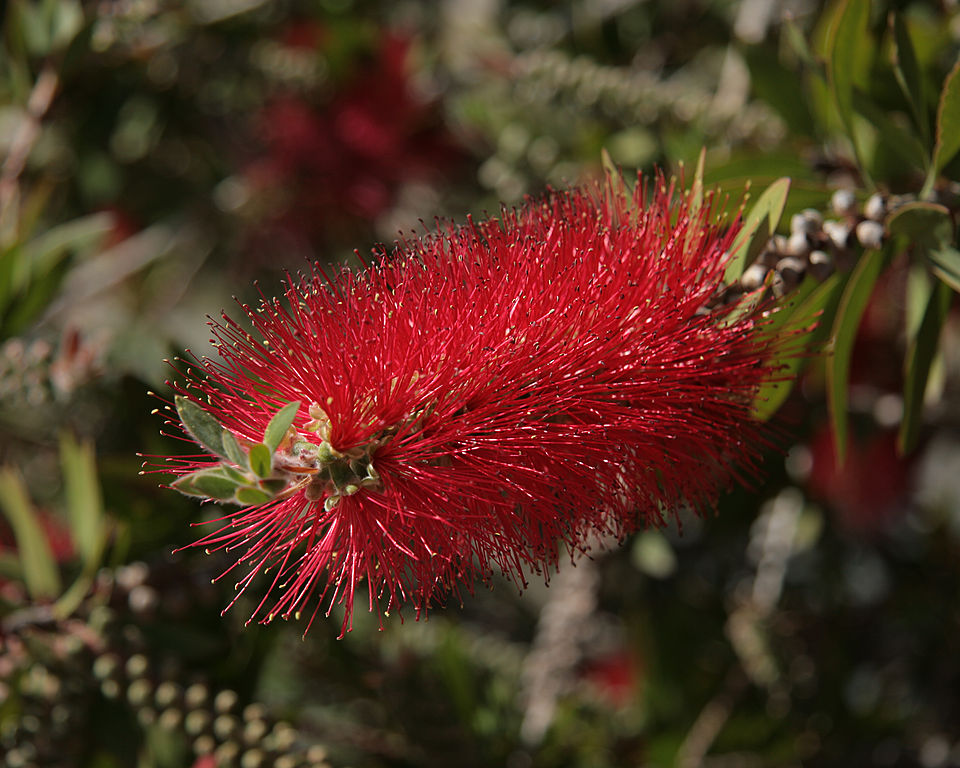
Callistemon citrinus, the crimson bottlebrush, produces the most structurally distinctive flowers of any bonsai species — cylindrical spikes of brilliant scarlet stamens up to 10 cm long that give the genus its common name, appearing in late spring and sometimes repeated in late summer. The narrow, lemon-scented leaves (when crushed), grey-brown furrowed bark on old trunks, and tolerance of heat, drought, and alkaline soils make it a practical outdoor bonsai for warm-climate practitioners. The persistent woody seed capsules arranged in beads along branches remain for years and add textural interest to the winter composition.
Callistemon citrinus (Curtis) Skeels is an evergreen shrub to small tree reaching 4 m, native to southeastern Australia where it grows along creek banks, in woodland, and in scrub from coastal to montane habitats. The leaves are 3-7 cm long, lanceolate, stiff, mid-green, with a citrus fragrance when crushed from the oil glands visible against the light. Bark on old stems is grey-brown, rough and furrowed. Flowers are produced in dense cylindrical spikes 6-10 cm long at the tips of previous season's growth — the 'bristles' of the bottlebrush are the conspicuous red stamens tipped with yellow pollen anthers; the petals are reduced and inconspicuous. After flowering, the shoot continues growing beyond the flower spike, leaving a ring of persistent, hard, seed capsules 5-6 mm diameter around the branch that remain for many years. Fruit capsules in species typically require fire to open and release seed.
| Common Name | Crimson Bottlebrush | Family | Myrtaceae |
| Origin | Australia | Indoor/Outdoor | Outdoor |
| Bonsai Tradition | Modern | Japanese Name | — |
| Difficulty | Beginner | Group | Broadleaf Evergreen |
| Recommended Styles | Moyogi (Informal Upright), Shakan (Slanting), Multi Trunk | ||
| Size Categories | Shohin (15–20 cm), Chuhin (25–46 cm), Omono (46–76 cm) | ||
History & Tradition
Callistemon bonsai has developed primarily in Australia and New Zealand where the genus is native, and in warm-climate regions where outdoor culture is possible. Australian bonsai practitioners have developed the species more than any other country, with growing expertise in styling techniques appropriate to its distinctive growth and flowering characteristics. In the global bonsai community, Callistemon represents Australian native species practice.
About Broadleaf Evergreen Bonsai
Broadleaf evergreen bonsai maintain year-round foliage while offering the leaf detail and trunk character of deciduous trees. Boxwood (Buxus) develops exceptionally dense foliage that can be refined into precise cloud-like pads. Olive trees (Olea europaea) bring Mediterranean character with their silver-green leaves and ancient-looking hollowed trunks. Ilex (holly) species offer dark glossy foliage and occasional berry displays. Privet (Ligustrum) grows vigorously and tolerates heavy styling, making it a productive training species. Camellia bonsai provide winter flowering combined with glossy, architectural foliage. These species generally tolerate shade better than conifers and deciduous trees, making them versatile additions to any collection.
Botanical Profile
| Family | Myrtaceae | Genus | Callistemon |
| Species | citrinus | Plant Type | evergreen tree |
| Origin | Australia | Growth Rate | moderate |
| Foliage Type | evergreen | Bark Character | grey-brown, furrowed |
| Autumn Color | Height Range | 15-70 |
Callistemon citrinus (Curtis) Skeels belongs to family Myrtaceae. Following recent molecular studies, most Callistemon species have been transferred to the genus Melaleuca — the current accepted name is Melaleuca citrina (Curtis) Dum.Cours., though Callistemon citrinus remains in very wide horticultural use. Chromosome number 2n=22. The persistent seed capsules are a distinctive Callistemon feature. Cold-hardy to USDA zone 8-9 depending on provenance.
Bonsai Styles
| Style | Japanese Name |
|---|---|
| Moyogi | Informal Upright |
| Shakan | Slanting |
| Multi Trunk |
Informal upright suits the irregular branching and natural drooping branch tips of wild Callistemon. Semi-weeping or slanting styles emphasize the naturally pendulous branch tips. Cascade suits collected cliff-face material. The flower spikes appear at branch tips — branch structure design should maximize the number and visibility of shoot tips for the flowering period. The persistent seed capsule rings along branches are distinctive textural features to be incorporated into the composition rather than removed.
Group Style Guide
Literati (bunjin) style suits boxwood and olive, emphasizing their naturally sparse, aged character. Informal upright is the most versatile style for broadleaf evergreens, accommodating various trunk shapes. Olive bonsai often develop hollowed trunks that suit dramatic driftwood and deadwood features. Root over rock works well with fig and privet species that develop strong surface roots. Broom style (hokidachi) is effective for dense-growing species like privet and boxwood. Multi-trunk and clump styles suit species that naturally produce basal shoots.
Trunk & Nebari
| Nebari Development | easy | Deadwood Suitability | not_suitable |
| Bark Scarring Risk | moderate | Bark Character | grey-brown, furrowed |
Old collected Callistemon from creek banks or rocky hillsides develops outstanding trunk character — deeply furrowed grey-brown bark and strong trunk movement from exposure to seasonal floods. Container-raised trunk development is moderate. Surface roots respond to root-combing. The rough bark texture develops on trunks over 3 cm diameter.
Deadwood Techniques
The rough, furrowed grey-brown bark creates naturalistic transitions with deadwood features. Jin on branch stubs bleaches to an attractive pale grey that contrasts with the living bark. The persistent seed capsule rings on branches are not deadwood but function as permanent textural features that visually reference the species' natural flowering-and-continuing-growth cycle.
Wiring & Shaping
Wire during the growing season with aluminum. The somewhat brittle branches require careful technique. The distinctive flower spikes at branch tips mean that wiring and bending must be done after flowering and before the next season's terminal growth has committed to a flowering spike. Check wires every six to eight weeks.
| Wire Type | Bark Scarring Risk | Best Season |
|---|---|---|
| Aluminum | Lower (softer wire) | Late autumn / early spring |
| Annealed copper | Higher (holds shape better) | Late autumn / early spring |
🌍 Distribution Map
Native origin: Australia
Pruning & Pinching
| Ramification Quality | medium | Leaf/Needle Reduction | good |
Prune after flowering in early summer, cutting back beyond the spent flower spike to encourage branching from the new growth that continues beyond it. Do not remove the persistent seed capsule rings — these are part of the branch's distinctive character. Back-budding from old wood is possible but less reliable than in privets — avoid pruning into completely bare wood. Maintain foliage on all retained branches.
Watering
C. citrinus tolerates drought once established but performs best with consistent moisture during the growing season. The creek-bank origin indicates tolerance of wet feet during wet seasons — more waterlogging-tolerant than most Myrtaceae. In container culture, water thoroughly when the top two centimeters dry and ensure drainage is functioning. Reduce watering in winter.
Soil & Repotting
| Substrate Type | Standard Akadama Mix |
| Repotting Frequency | Every 2 years |
| Root Pruning Tolerance | moderate |
Repot every two to three years in early spring. A moderately free-draining mix with some organic matter — 50% akadama, 30% pumice, 20% composted bark — reflects the creek-bank native habitat that is richer in organic matter than typical bonsai substrates. Root pruning of up to one-third is tolerated. Unlike most Myrtaceae, C. citrinus is more tolerant of pH variation including slightly alkaline conditions.
Group Soil Recipes
Broadleaf evergreen substrate balances moisture retention with drainage: 50% akadama, 25% pumice, 15% lava rock, 10% composted bark. Olive bonsai prefer very fast-draining, mineral-rich substrate with extra pumice and minimal organic matter. Boxwood tolerates standard mixes. Privet and holly are undemanding regarding soil composition. Repot every 2–3 years in spring. Camellia prefers acidic substrate similar to azalea, using kanuma instead of akadama. Mediterranean species like olive and myrtle benefit from a limestone chip addition for calcium.
Fertilizing
| Season | NPK Ratio | Frequency | Notes |
|---|---|---|---|
| Spring | 10-10-10 | Every 2 weeks | Support new growth |
| Summer | 10-10-10 | Every 2 weeks | Sustain vigor |
| Autumn | 0-10-10 | Every 3–4 weeks | Harden off for winter |
| Winter | None | — | No feeding during dormancy |
Feed with balanced fertilizer from early spring through summer. Reduce nitrogen from late summer to encourage flower bud set. A phosphorus-emphasis fertilizer in late summer promotes the following spring's flower display. Stop feeding in autumn. The species is not a heavy feeder — moderate nutrition produces the best results.
Light & Placement
Full sun — a minimum of six hours of direct sun daily is required for the dense flower production that is the species' primary value. Cold-hardy to USDA zone 8-9. In cooler climates, greenhouse overwintering is needed. The species suits warm outdoor conditions in California, the Mediterranean, and Southern Australia. Summer heat does not cause problems — the species is naturally adapted to hot Australian summers.
Seasonal Placement Guide
Spring: New growth flushes; begin feeding with balanced fertilizer; prune to maintain shape as new growth extends. Summer: Regular watering; olive and Mediterranean species tolerate heat and some drought; protect boxwood from sunburn. Autumn: Reduce feeding; camellia buds swell for winter bloom; prepare cold-sensitive species for winter protection. Winter: Protect subtropical species from frost; olive trees need cool but frost-free conditions; camellia blooms in late winter. Boxwood and holly tolerate moderate cold.
Seasonal Care
| Season | Watering | Feeding | Key Tasks |
|---|---|---|---|
| Spring | Increasing | Resume / increase | Repotting, structural pruning, wiring |
| Summer | Maximum | Regular biweekly | Maintenance pruning, pinching, pest watch |
| Autumn | Decreasing | Reduce / stop | Wiring, structural work, winter preparation |
| Winter | Minimal | None (dormancy) | Protect roots, plan next season |
Spring: Main flowering display — enjoy without pruning during this period. Early summer: Post-bloom pruning is the critical shaping window. Summer: New growth development, monitor for pests, light feeding. Autumn: Reduce feeding, admire persistent seed capsule rings. Winter: Frost protection in zones 8 and colder, minimal watering.
Group Seasonal Guide
Spring: New growth flushes; begin feeding with balanced fertilizer; prune to maintain shape as new growth extends. Summer: Regular watering; olive and Mediterranean species tolerate heat and some drought; protect boxwood from sunburn. Autumn: Reduce feeding; camellia buds swell for winter bloom; prepare cold-sensitive species for winter protection. Winter: Protect subtropical species from frost; olive trees need cool but frost-free conditions; camellia blooms in late winter. Boxwood and holly tolerate moderate cold.
Pests & Diseases
Scale insects particularly favor the rough bark of old Callistemon — inspect and treat with horticultural oil. Sawfly larvae (Callistemon sawfly) can strip entire branches of leaves — treat with Bacillus thuringiensis. Witches' broom gall mite causes abnormal dense growth at shoot tips — cut out affected sections. Root rot in persistently waterlogged conditions despite the species' relative tolerance.
Group Pest Guide
Olive moth larvae mine leaves and bore into fruit; apply appropriate insecticide. Boxwood blight causes dark leaf spots and rapid defoliation; fungicide treatment and removal of affected growth is essential. Boxwood leafminer creates blistered leaves; treat with systemic insecticide in spring. Scale insects affect most broadleaf evergreens; treat with horticultural oil. Holly leaf miner creates serpentine trails in leaves; systemic insecticide in spring is effective. Sooty mold from honeydew-producing pests is common; treat the underlying pest infestation.
| Pest/Disease | Identification | Treatment |
|---|---|---|
| Scale Insects | Brown or white bumps on stems/branches | Horticultural oil, systemic insecticide, manual removal |
| Mealybugs | White cottony masses in leaf axils | Rubbing alcohol on cotton swab, systemic insecticide |
| Spider Mites | Fine webbing, stippled/bronzed foliage | Miticide spray, increase humidity, neem oil |
Propagation
Semi-hardwood cuttings in late summer root with IBA hormone at 20-24°C within six to eight weeks. Named cultivars must be propagated vegetatively. Seed germinates readily after brief heat treatment (simulate fire) — soaking in warm water for twenty minutes achieves this without actual fire. Seedlings take several years to reach flowering size.
Group Propagation Guide
Olive propagates from semi-hardwood cuttings or by salvaging ancient olive wood with some living cambium. Boxwood cuttings root readily in summer within 6–8 weeks. Privet is extremely easy from cuttings taken at almost any time during the growing season. Holly propagates from semi-hardwood cuttings under mist; berried varieties require both male and female plants. Camellia is typically grafted for named cultivars or propagated from semi-hardwood cuttings in summer. Mediterranean species like myrtle root easily from cuttings.
| Method | Timeline | Notes |
|---|---|---|
| Cuttings | Variable | Consult species-specific guides |
| Seeds | Variable | Consult species-specific guides |
Size Classification
Most effective at medium to large scale (40-80 cm) where the 6-10 cm flower spikes remain in proportion with the composition. The bottlebrush flowers are so distinctive and large that very small bonsai compositions struggle to display them proportionally. Medium scale allows the seed capsule rings along branches to be a visible design feature.
| Keshitsubo (3–8 cm) |
| Shito (5–10 cm) |
| Mame (5–15 cm) |
| Shohin (15–20 cm) ✅ |
| Komono (15–25 cm) |
| Chuhin (25–46 cm) ✅ |
| Omono (46–76 cm) ✅ |
| Dai (76–122 cm) |
| Imperial (122+ cm) |
Varieties & Cultivars
Callistemon citrinus 'Splendens' is the most widely grown cultivar — brilliant scarlet bottlebrushes. 'White Anzac' has white flower spikes. 'Candy Pink' has pink flowers. 'Little John' is a dwarf, compact form with smaller flower spikes — useful for smaller-scale bonsai. The closely related Callistemon viminalis (weeping bottlebrush) has strongly pendulous branches suited to cascade style.
Group Varieties
Buxus harlandii (Harland boxwood) is the premier bonsai boxwood with naturally small leaves. Olea europaea (olive) develops ancient-looking trunks and tolerates heavy styling. Ligustrum (privet) grows vigorously with small leaves. Ilex (holly) species offer dark glossy foliage and occasional berries; I. crenata has tiny leaves. Myrtus communis (common myrtle) has fragrant foliage and white flowers. Camellia sasanqua is more suited to bonsai than C. japonica due to smaller flowers and leaves. Serissa foetida (snow rose) has tiny leaves and flowers but is temperamental.
Buying Guide & Display
Native plant nurseries and general garden centers in warm-climate regions stock multiple Callistemon cultivars at modest prices. Select plants with genuine trunk caliper and visible bark furrowing. 'Little John' dwarf selections provide compact material for smaller-scale bonsai. Verify cold hardiness for your specific climate — provenance makes a significant difference in cold tolerance.
| Check | What to Look For |
|---|---|
| Trunk | Good taper, interesting movement, no reverse taper at graft union |
| Nebari | Even radial root spread, no circling or crossing roots |
| Roots | Healthy white root tips visible, no root rot smell |
| Branches | Well-placed primary branches, no large scars or stubs |
| Health | Vibrant foliage color, no pests, firm bark, strong buds |
Troubleshooting
Sparse flowering despite adequate light indicates either pruning at the wrong time (removing developing flower buds) or excessive nitrogen suppressing reproductive growth — adjust both. Leaf bronzing in winter in exposed positions is normal cold-weather pigmentation and not a disease sign. Witches' broom gall causes dense abnormal growth at shoot tips — cut out affected sections promptly before the gall spreads. Failure to back-bud after heavy pruning indicates the pruning went too deep into bare wood — cut back to the nearest foliage-bearing branch and feed consistently to stimulate recovery.
Common Problems
Display & Exhibition
Display during the peak flowering period — the crimson bottlebrush spikes against the narrow-leaved foliage are visually unmistakable and immediately impactful. A heavy, unglazed terracotta or grey rectangular container suits the rough bark and strong flowering character. The seed capsule bead rings along older branches add textural interest during the non-flowering season.
Group Display Guide
Broadleaf evergreen bonsai provide year-round display options. Olive bonsai are displayed to emphasize their ancient, gnarled trunks and silver-green foliage. Boxwood is showcased for its dense, refined pad structure. A Mediterranean-themed display with stone accents suits olive and myrtle. Camellia is displayed during its winter bloom season, often paired with a seasonal scroll. Glazed pots in subtle greens or blues complement the evergreen foliage. The display should emphasize the natural character of the species.
Frequently Asked Questions
How often should I water my Crimson Bottlebrush bonsai?
Water your Crimson Bottlebrush bonsai when the top layer of soil begins to dry. During summer this may be daily or even twice daily for outdoor trees; in winter, reduce frequency significantly. Always water thoroughly until water runs from the drainage holes, then allow the soil to partially dry before the next watering.
Can I keep Crimson Bottlebrush bonsai indoors?
No. Crimson Bottlebrush is an outdoor species that requires natural sunlight, air circulation, and seasonal temperature changes including winter dormancy. Growing it permanently indoors will weaken and eventually kill the tree.
What bonsai styles suit Crimson Bottlebrush?
Crimson Bottlebrush is particularly well-suited to Moyogi, Shakan, Multi Trunk. Choose a style that complements the existing trunk movement and natural growth habit of your individual tree.
When should I repot my Crimson Bottlebrush bonsai?
Repot Crimson Bottlebrush every 2 years in early spring, just before the buds begin to swell. Signs that repotting is needed include water sitting on the surface without soaking in, roots circling inside the pot, or reduced vigor despite proper care.
How do I wire Crimson Bottlebrush bonsai?
Use aluminum wire for Crimson Bottlebrush. Apply wire at a 45-degree angle, with wire thickness approximately one-third of the branch diameter. Wire during the dormant season when possible, and check wires every 2–4 weeks during the growing season to prevent them cutting into the bark.
Is Crimson Bottlebrush good for beginners?
Yes, Crimson Bottlebrush is an excellent choice for beginners. It is forgiving of occasional care mistakes and responds well to basic bonsai techniques.
What soil mix should I use for Crimson Bottlebrush?
Use a well-draining bonsai mix for Crimson Bottlebrush. The key principle is excellent drainage combined with adequate moisture retention. Never use standard garden soil or purely organic potting mix for bonsai, as these compact over time and suffocate roots.
How do I promote ramification on Crimson Bottlebrush?
Ramification on Crimson Bottlebrush is rated as medium. Promote finer branching through repeated cycles of growing and cutting back. Allow shoots to extend 4–6 nodes, then prune back to 1–2 nodes. Over multiple growing seasons, this creates increasingly dense and refined branch structure.
When is the best time to prune Crimson Bottlebrush?
Perform structural pruning on Crimson Bottlebrush during the dormant season (late autumn to late winter) when the tree's energy reserves are in the roots. Maintenance pruning and pinching of new growth can be done throughout the growing season to maintain shape and promote density.
How cold-hardy is Crimson Bottlebrush?
Crimson Bottlebrush should be protected from temperatures below 10°C. Hardy in USDA zones 9-11. Protect container roots by placing in an unheated garage, cold frame, or burying the pot in ground soil during extreme cold.
Quick Reference Summary
| Scientific Name | Callistemon citrinus |
|---|---|
| Common Name | Crimson Bottlebrush |
| Family | Myrtaceae |
| Origin | Australia |
| Group | Broadleaf Evergreen |
| Indoor/Outdoor | Outdoor |
| Difficulty | Beginner |
| Bonsai Tradition | Modern |
| Wiring Suitability | good |
| Wire Type | aluminum |
| Ramification | medium |
| Leaf/Needle Reduction | good |
| Nebari Development | easy |
| Deadwood Suitability | not_suitable |
| Substrate | — |
| Repotting Frequency | Every 2 years |
| USDA Zones | 9-11 |


