Vernonia fasciculata (Common Ironweed)
Vernonia fasciculata (Common Ironweed)


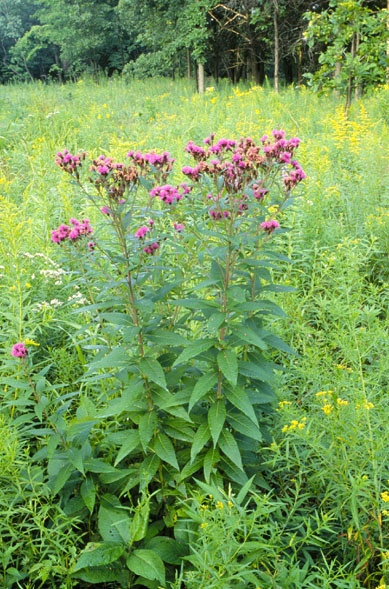
Table of Contents
- Introduction
- Identification Guide
- Taxonomy & Classification
- Bloom & Pollinators
- Similar Species
- Native Range & Habitat
- Growing from Seed
- Garden Cultivation
- Companion Planting
- Wildlife Value
- Conservation
- Seasonal Interest
- Landscape Design
- Varieties & Cultivars
- Folklore & Ethnobotany
- Beginner's Guide
- FAQ
🌻 Introduction
Vernonia fasciculata is a stately late-summer perennial of moist tallgrass prairies and stream margins, producing dense flat-topped clusters of intense purple-violet flower heads on robust stems 60-150 cm tall from July through September. The vivid purple color is among the richest found in any North American wildflower, and its late-season bloom coincides perfectly with goldenrods to create the iconic purple-and-gold autumn prairie display.
Stems are stout, erect, smooth or finely hairy, often reddish-purple tinged, and branching in the upper portion into broad, flat-topped corymbs. Leaves are alternate, narrowly lanceolate, 10-20 cm long, sharply serrate, dark green above and paler beneath with tiny resin dots visible under magnification. Flower heads are 8-12 mm across, each containing 15-30 disc florets (no ray florets); the deep purple color is derived entirely from the tubular disc corollas. Achenes are ribbed, 3-4 mm long, topped with a double pappus of purple-tinged bristles.
Quick Facts
| Common Name | Common Ironweed |
| Family | Asteraceae |
| Order | Asterales |
| Group | Prairie Wildflowers |
| Origin | Central North America |
| Bloom Season | Mid to late summer |
| Height | 90-180 cm |
| Conservation | Least Concern |
🔍 Identification Guide
The intense purple disc-only heads in flat-topped clusters distinguish Vernonia from all other late-summer prairie plants. No ray florets are present; the apparent 'petals' are the elongated lobes of the disc corollas. The alternate, narrow, serrate leaves with resin dots underneath (visible with a hand lens) confirm the genus. Distinguished from V. noveboracensis by its shorter stature and prairie (not wetland) habitat, and from V. gigantea by smaller heads with fewer florets.
Flower Anatomy
| Feature | Description |
|---|---|
| Bloom Color | Purple, Violet |
| Flower Shape | Flat-topped clusters of fluffy disc flower heads |
| Flower Size | 0.5-1 cm |
| Leaf Type | Lanceolate, finely serrate, dark green, smooth |
| Leaf Arrangement | Alternate |
| Growth Habit | Upright, clump-forming, stout |
| Root Type | Rhizomatous with fibrous roots |
Field Identification Checklist
- Flower shape: Flat-topped clusters of fluffy disc flower heads
- Bloom color: Purple, Violet
- Leaf type: Lanceolate, finely serrate, dark green, smooth
- Leaf arrangement: Alternate
- Growth habit: Upright, clump-forming, stout
- Height: 90-180 cm
- Root system: Rhizomatous with fibrous roots
Detailed Morphology
All florets are perfect and disc-type, with deeply 5-lobed tubular corollas 8-10 mm long. The style branches are long and curling, extending well beyond the corolla, creating the feathery appearance of each head. The double pappus consists of an outer ring of short scales and an inner ring of long, capillary bristles that aid wind dispersal. Resin dots on leaf undersides contain sesquiterpene lactones with antiherbivore properties.
🧬 Taxonomy & Classification
Vernonia fasciculata is sometimes treated as V. fasciculata var. fasciculata with V. fasciculata var. corymbosa as a western variant. The genus in North America has been subject to recent taxonomic revision, with approximately 20 species recognized. Some taxonomists have split North American Vernonia into smaller genera, but this has not been widely accepted. Chromosome number is 2n = 34.
🐝 Bloom & Pollinators
Flowering peaks from late July through September, filling the gap between midsummer coneflowers and autumn asters. Each flat-topped cluster contains 20-50 individual heads opening over 2-3 weeks. Individual heads last 4-6 days. The protandrous flowering (pollen shed before stigma receptivity) enforces outcrossing. The purple color is particularly attractive to butterfly pollinators. Nectar production is copious, measured at 2-4 microliters per head per day.
Pollinator Relationships
One of the premier butterfly plants of the tallgrass prairie, attracting swallowtails (Papilio polyxenes, P. glaucus), great spangled fritillaries, and monarchs. Large bumble bees (Bombus pensylvanicus, B. fervidus) are the most efficient pollinators. Specialist sweat bees (Lasioglossum spp.) collect pollen specifically from Vernonia. The flat-topped inflorescence provides stable landing platforms for large butterflies. Over 35 visitor species recorded at single sites.
Bloom Details
| Bloom Season | Mid to late summer |
| Bloom Colors | Purple, Violet |
| Flower Size | 0.5-1 cm |
| Cut Flower | Yes |
🔎 Similar Species
Vernonia noveboracensis (New York Ironweed) is taller (120-200 cm), has larger heads with 30-45 florets (vs. 15-30), and prefers wetter habitats. V. gigantea (Tall Ironweed) reaches 200-300 cm with even larger heads. V. baldwinii (Western Ironweed) has densely woolly-hairy undersides to the leaves. Liatris species have similar purple color but heads are arranged in vertical spikes, not flat-topped clusters. Eupatorium purpureum has whorled leaves and pink-purple (not violet-purple) flowers.
Known Look-Alikes
| Species | Group | Key Differences |
|---|---|---|
| Vernonia noveboracensis (New York Ironweed) | Wetland Wildflowers | Height: 120-250 cm; Habitat: Wet meadows, streambanks, floodplains, ditches |
| Vernonia gigantea | Unknown | Compare all identifying features carefully |
🌍 Native Range & Habitat
Native to moist tallgrass prairies, wet meadows, and stream terraces from Ohio to South Dakota and south to Oklahoma and Mississippi. Prefers seasonally moist, loamy to clay soils with moderate fertility. An indicator species for mesic to wet prairie remnants. Fire-responsive; plants grow taller and produce more flower heads after spring burns. Often associated with Silphium integrifolium, Spartina pectinata, and Helianthus grosseserratus.
Range & Habitat
| Native Range | Central United States from Ohio to South Dakota south to Texas |
| Habitat | Moist prairies, streambanks, ditches, wet meadows |
| Invasive Status | Native Species |
| Conservation Status | Least Concern |
🗺 Distribution Map
Native distribution of Common Ironweed (range: Central United States from Ohio to South Dakota south to Texas).
🌱 Growing from Seed
Seed requires 30-60 days of cold-moist stratification at 1-4°C for optimal germination. Sow on the surface; light is required. Germination occurs at 18-22°C over 14-28 days with rates of 40-60%. Seedlings develop slowly in the first year, forming a basal rosette. First flowering in the second or third year from seed. Direct sow in autumn at 2-3 g per 100 m² for prairie plantings. Division of established clumps in spring is the faster propagation method.
Propagation Methods
- Seed
- Division
Seed Starting Guide
| Best Sowing Season | Autumn or early spring for most species |
| Germination | Cold-stratify 4-6 weeks; germinates in 14-21 days |
🏡 Garden Cultivation
Plant in full sun in average to moist, loamy soil. Tolerates clay well. Space 60-75 cm apart. Unlike many prairie plants, benefits from moderate fertility and consistent moisture. Pinch stem tips at 30 cm height in late May to reduce final height and increase branching. Cut back in late winter. Does not spread aggressively. Hardy to USDA zone 4. Provides invaluable late-season purple color missing from most garden palettes.
Site Requirements
| Requirement | Details |
|---|---|
| Sun Exposure | Full sun to part shade |
| Soil Type | Moist, Loamy, Clay |
| Soil pH | Slightly acidic to neutral |
| Moisture | Moderate to high |
| USDA Zones | 4-8 |
Additional Traits
- Good cut flower — long-lasting in arrangements
🤝 Companion Planting
The classic pairing is with Solidago rigida and S. speciosa for the purple-and-gold autumn palette. Plant behind Echinacea purpurea and Rudbeckia subtomentosa for seasonal succession. Effective with Eutrochium purpureum for an all-purple late-summer composition. Grasses including Panicum virgatum and Sorghastrum nutans provide foil for the dense purple clusters. Asters (Symphyotrichum novae-angliae) extend the purple display into October.
Recommended Companion Plants
🦋 Wildlife Value
Among the top 10 native plants for butterfly attraction in the tallgrass prairie region. Achene seeds are consumed by goldfinches and sparrows in autumn. The dense foliage provides cover for prairie voles and nesting grassland birds. Specialist leaf-mining flies (Agromyzidae) create characteristic trails in the foliage. Deer avoid the bitter foliage due to sesquiterpene lactones. The standing dead stems overwinter beneficial insects.
Wildlife Interactions
- Late-season nectar for monarchs and swallowtails
- Seeds eaten by songbirds
| Deer Resistant | Yes — deer typically avoid this plant |
| Rabbit Resistant | Yes — rabbits typically avoid this plant |
🌿 Conservation
Globally Secure (G5) but habitat-dependent on moist prairie and wet meadow communities that have declined 85-95% across the Midwest. Listed as Endangered or Threatened in several northeastern states at the edge of its range. Used in prairie restorations, particularly on sites with heavier soils where dry-prairie species struggle. Effective in bioswale and rain garden plantings that mimic its natural hydrology.
📅 Seasonal Interest
Shoots emerge in April as robust, often reddish-tinted stems. Through June-July, the tall stems develop a mass of dark green, sharply toothed foliage. Late July through September brings the brilliant purple bloom. Dried seed heads with fluffy pappus persist into November, catching golden autumn light. Standing dead stems provide winter structure. Spring cleanup is straightforward; cut old stems to 10 cm.
🏨 Landscape Design
Essential for the back of native plant borders and naturalistic meadow gardens. The intense purple provides a color that is scarce in the late-summer garden palette. Plant in groups of 5-7 for visual weight. Excellent for rain gardens, bioswales, and stream buffer plantings where moisture is available. Not suitable for dry, sandy sites. Use as a tall screen or background plant in butterfly gardens. The robust form handles wind without staking.
Design Considerations
- Growth form (Upright, clump-forming, stout) determines placement in borders and naturalistic plantings
- At 90-180 cm, consider position relative to sight lines and companion heights
- Allow 60-90 cm spacing for natural spread
- Suitable for cutting gardens and floral arrangements
🏷️ Varieties & Cultivars
No named cultivars of V. fasciculata are commercially available. Prairie-source seed from different provenances varies in height (60-150 cm) and flower intensity. V. lettermannii 'Iron Butterfly' is a different species selected for narrow, thread-like leaves and compact 60 cm habit. V. noveboracensis is more commonly offered in eastern nurseries. Wild-type V. fasciculata is best sourced from regional native plant suppliers.
📜 Folklore & Ethnobotany
The common name 'ironweed' refers to the tough, wiry stems that resist cutting and persist through winter. The Cherokee used root tea for blood purification and menstrual complaints. The genus is named for William Vernon, a 17th-century English botanist who collected in Maryland. In agricultural areas, ironweed was historically viewed as a pasture weed indicating overgrazing, since cattle avoid its bitter foliage.
Traditional & Ethnobotanical Uses
- Root tea used by Native Americans for stomach troubles
- Bitter tonic
Medicinal & Herbal Uses
Cherokee root tea was used for blood purification, menstrual irregularity, and digestive complaints. The root contains sesquiterpene lactones (vernolide, vernodalol) that show anti-inflammatory and antitumoral activity in laboratory studies. No clinical applications exist. The bitter compounds in the foliage are the same sesquiterpene lactones that deter herbivory. Not used in current herbal practice. The plant is not known to be toxic.
💡 Beginner's Guide
Easy to grow in any sunny, moderately moist garden site. Start with nursery transplants for quickest results. Provide average to moist soil; this species is less drought-tolerant than most prairie plants. Pinch stems in late May to control height if the 150 cm maximum is too tall for your border. No pest or disease problems of note. Pair with goldenrods for an instant autumn prairie effect. Leave standing through winter for wildlife habitat.
Common Mistakes to Avoid
Most prairie seeds require 60-90 days of cold-moist stratification to break dormancy; sow in late autumn or pre-chill seed
Prairie plantings take 2-3 years to establish; aggressive weed control during this period is critical for success
Periodic prescribed burning (every 2-4 years) is essential for prairie health, removing thatch and suppressing woody invaders
Most prairie perennials invest in root growth during the first 1-2 years and bloom from year three onwards
Growing Tips
Troubleshooting
Plants may flop if grown in shade or overly rich, moist soil; ensure full sun and pinch early. Leaf spot diseases occasionally disfigure lower foliage in humid summers; strip affected leaves. Rust appears as orange pustules in wet years; fungicides are rarely warranted. Plants in dry sites are shorter and flower less prolifically; supplement water during drought. Division is rarely needed as clumps expand slowly.
Quick Start Checklist
- Provide full sun to part shade conditions
- Use moist, loamy, clay soil
- Water: moderate to high
- Propagate by: seed, division
- Hardy in USDA zones 4-8
❓ Frequently Asked Questions
How do I grow Common Ironweed from seed?
Vernonia fasciculata can be propagated from seed. Cold-stratify 4-6 weeks; germinates in 14-21 days
When does Common Ironweed bloom?
Vernonia fasciculata blooms mid to late summer, producing flowers in purple, violet.
Is Common Ironweed deer resistant?
Yes, Vernonia fasciculata is considered deer resistant. Deer typically avoid this plant, making it a good choice for gardens in areas with high deer pressure.
What pollinators does Common Ironweed attract?
Vernonia fasciculata attracts butterflies, bees. It is a valuable nectar and pollen source for these species.
What are the best companion plants for Common Ironweed?
Good companion plants for Vernonia fasciculata include Liatris spicata, Solidago rigida, Helianthus maximiliani. These species share similar growing requirements and complement each other ecologically.
Is Common Ironweed invasive?
No, Vernonia fasciculata is a native species and is not considered invasive. It is well-adapted to its natural range and supports local ecosystems.
What USDA zones is Common Ironweed hardy in?
Vernonia fasciculata is hardy in USDA zones 4 to 8. It may survive outside this range with appropriate microclimate management or winter protection.
How tall does Common Ironweed grow?
Vernonia fasciculata typically reaches 90-180 cm in height. Actual size may vary depending on growing conditions, soil quality, and climate.
What soil conditions does Common Ironweed prefer?
Vernonia fasciculata prefers moist, loamy, clay with slightly acidic to neutral pH soil. Good drainage is important for most wildflower species.
What are similar species to Common Ironweed?
Species that may be confused with Vernonia fasciculata include Vernonia noveboracensis, Vernonia gigantea. Careful comparison of flower shape, leaf structure, and habitat can help distinguish between them.
📋 Summary — Vernonia fasciculata (Common Ironweed)
Vernonia fasciculata is a stately late-summer perennial of moist tallgrass prairies and stream margins, producing dense flat-topped clusters of intense purple-violet flower heads on robust stems 60-150 cm tall from July through September. The vivid purple color is among the richest found in any North American wildflower, and its late-season bloom coincides perfectly with goldenrods to create the iconic purple-and-gold autumn prairie display.
Quick Reference
| Family | Asteraceae |
| Bloom Season | Mid to late summer |
| Height | 90-180 cm |
| Sun | Full sun to part shade |
| USDA Zones | 4-8 |
| Deer Resistant | Yes |
Bonsai · Houseplants · Mushrooms · Herbs · Vegetables · Roses · Ferns · Climbing Plants · Aquatic Plants