Isopyrum biternatum (False Rue Anemone)
Isopyrum biternatum (False Rue Anemone)


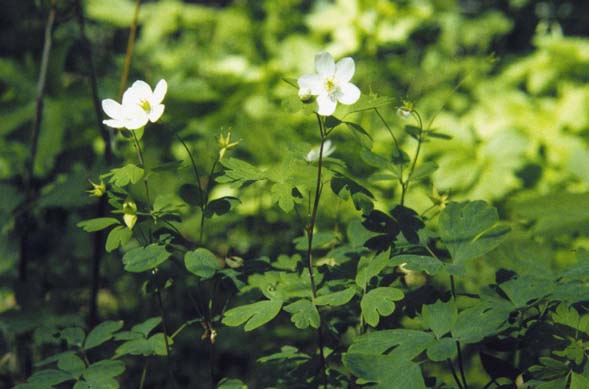
Table of Contents
- Introduction
- Identification Guide
- Taxonomy & Classification
- Bloom & Pollinators
- Similar Species
- Native Range & Habitat
- Growing from Seed
- Garden Cultivation
- Companion Planting
- Wildlife Value
- Conservation
- Seasonal Interest
- Landscape Design
- Varieties & Cultivars
- Folklore & Ethnobotany
- Beginner's Guide
- FAQ
🌻 Introduction
Isopyrum biternatum is an airy, delicate spring ephemeral reaching 15-30 cm, producing loose clusters of pristine white 5-petaled flowers above finely divided biternate foliage that creates a lace-like texture across the forest floor. Spreading via tiny grain-like tubers, it forms ethereal colonies that shimmer in the April breeze before retreating underground by early summer.
Stems are slender, smooth, wiry, 15-30 cm tall, freely branching. Leaves are biternately compound, with leaflets rounded to obovate, 1-2 cm long, shallowly 3-lobed, thin-textured, pale green, on thread-like petioles. The overall effect is extremely delicate and airy. Flowers are borne singly or in loose few-flowered clusters, each 12-18 mm across, with 5 white petal-like sepals (true petals absent or vestigial), 20-40 stamens, and 2-6 free pistils. Fruit is a cluster of 2-4 divergent follicles, each 5-8 mm long, containing 3-6 dark brown seeds. The root system consists of small grain-like tubers 2-4 mm in diameter attached to fine roots.
Quick Facts
| Common Name | False Rue Anemone |
| Family | Ranunculaceae |
| Order | Ranunculales |
| Group | Spring Ephemeral Wildflowers |
| Origin | Eastern North America |
| Bloom Season | Early to mid spring |
| Height | 15-30 cm |
| Conservation | Least Concern |
🔍 Identification Guide
The combination of delicate biternate foliage, small white 5-sepaled flowers, and rich mesic woodland habitat identifies this species. Most commonly confused with Thalictrum thalictroides (rue anemone), which has similar foliage and flowers but grows from a cluster of dahlia-like tubers (not grain-like tubers) and has more flowers per umbel with a slightly different petal shape. False rue anemone typically flowers 1-2 weeks earlier than true rue anemone and has a more open, branching flower arrangement rather than an umbel-like cluster.
Flower Anatomy
| Feature | Description |
|---|---|
| Bloom Color | White |
| Flower Shape | Delicate 5-petaled white flowers in loose clusters |
| Flower Size | 1-1.5 cm |
| Leaf Type | Biternately compound, leaflets rounded and lobed, thin, resembling Thalictrum |
| Leaf Arrangement | Alternate |
| Growth Habit | Delicate, airy, forms colonies via tubers, dormant by summer |
| Root Type | Small grain-like tubers |
Field Identification Checklist
- Flower shape: Delicate 5-petaled white flowers in loose clusters
- Bloom color: White
- Leaf type: Biternately compound, leaflets rounded and lobed, thin, resembling Thalictrum
- Leaf arrangement: Alternate
- Growth habit: Delicate, airy, forms colonies via tubers, dormant by summer
- Height: 15-30 cm
- Root system: Small grain-like tubers
Detailed Morphology
The 5 white petaloid sepals are elliptic-obovate, 6-10 mm long, serving as the showy structures since true petals are absent or reduced to minute nectaries at the sepal bases. Stamens 20-40, with slender filaments and small yellow anthers. Pistils 2-6, free, each developing into a follicle with 3-6 seeds. The grain-like tubers are tiny (2-4 mm), starchy, producing new tubers annually on short stolons. Individual tubers weigh only 0.02-0.05 g. The entire plant has a fragile, translucent quality that distinguishes it from the slightly more robust Thalictrum thalictroides.
🧬 Taxonomy & Classification
Isopyrum biternatum was described by Torrey and Gray in 1838. The species is now placed by many authorities in Enemion as E. biternatum based on molecular phylogenetic evidence separating New World species from Old World Isopyrum. The family is Ranunculaceae. The genus Isopyrum sensu stricto is restricted to Eurasia. The name Isopyrum biternatum persists in most regional floras pending broader acceptance of the Enemion transfer. Chromosome number is 2n = 14.
🐝 Bloom & Pollinators
Flowering from late March through early May, among the earliest spring ephemerals. Individual flowers last 5-7 days. The open flower architecture provides easy access to pollen for small insects. Nectar is produced in tiny amounts from vestigial petal nectaries. Follicles ripen by late May, splitting along the ventral suture to release dark seeds. The entire above-ground plant senesces by mid-June. Self-sowing is common, with established colonies expanding steadily through both tuber multiplication and seed production.
Pollinator Relationships
Visited by small solitary bees (Andrena, Lasioglossum), small flies (Syrphidae), and early-season gnats seeking pollen. The delicate open flowers accommodate the smallest insect visitors. No specialised pollinator relationship exists; the wide-open architecture ensures even inefficient visitors may transfer pollen. Self-pollination can occur as the numerous stamens shed pollen onto the receptive stigmas within the same flower. Bee flies (Bombylius major) are conspicuous visitors, hovering at the flowers and inserting their long proboscis.
Bloom Details
| Bloom Season | Early to mid spring |
| Bloom Colors | White |
| Flower Size | 1-1.5 cm |
| Self-Seeding | Yes |
🔎 Similar Species
Thalictrum thalictroides (rue anemone) is the closest look-alike, with similar biternate foliage and white flowers, but it has flowers in umbel-like clusters (not solitary or loosely branched), slightly larger flowers, and dahlia-like tuberous roots (not grain-like tubers). Anemonella thalictroides is a synonym for Thalictrum thalictroides. Aquilegia canadensis (wild columbine) has somewhat similar biternate foliage but red-and-yellow spurred flowers. Coptis trifolia (goldthread) has trifoliate (not biternate) evergreen leaves and a bright yellow rhizome.
Known Look-Alikes
| Species | Group | Key Differences |
|---|---|---|
| Thalictrum thalictroides (Rue Anemone) | Spring Ephemeral Wildflowers | Color: White, Pink; Shape: Delicate 5-10 petal-like sepals in loose umbel, anemone-like; Height: 10-25 cm; Habitat: Open deciduous woodlands, rocky slopes, woodland edges |
| Enemion biternatum | Unknown | Compare all identifying features carefully |
🌍 Native Range & Habitat
Native from Ontario to Minnesota and south to Florida and Texas in rich mesic deciduous forests, bottomland forests, and floodplains at 50-800 m elevation. Most abundant in the central Mississippi and Ohio River valleys. Characteristic of forests with deep alluvial humus on circumneutral soils. Less restricted to calcareous substrates than some spring ephemerals, tolerating mildly acidic to neutral soils (pH 5.5-7.5). Often grows in the same microsites as Claytonia virginica and Cardamine concatenata.
Range & Habitat
| Native Range | Eastern USA |
| Habitat | Rich mesic deciduous woods, bottomlands, floodplain forests |
| Invasive Status | Native Species |
| Conservation Status | Least Concern |
🌱 Growing from Seed
Sow fresh seed immediately upon ripening in late May at 2-3 mm depth in moist humus. Seeds require cold stratification (60-90 days at 2-4°C) and germinate the following spring with 40-60% success rates. Seedlings produce tiny biternate leaves in year one and a few tubers. Flowering begins in year 2-3. Division of tuber clusters after dormancy in July is also effective. The grain-like tubers can be separated and replanted individually, each producing a new plant the following spring.
Propagation Methods
- Seed
- Tuber division
Seed Starting Guide
| Best Sowing Season | Autumn or early spring for most species |
| Self-Seeding | Yes — this species will naturalize by self-sowing |
| Germination | Sow fresh seed in autumn; cold stratification required; divide tuber clusters after dormancy |
🏡 Garden Cultivation
Plant tuber clusters 3-5 cm deep in humus-rich, moist soil in partial to full deciduous shade. Space 10-15 cm apart. Hardy in USDA zones 4-8. Mulch with leaf litter. The delicate texture creates an ethereal quality unlike bolder woodland plants. Self-sows and spreads by tuber multiplication to form expanding colonies. One of the easier spring ephemerals to establish due to rapid tuber multiplication and self-sowing. The gossamer-like foliage and white flowers are most effective en masse.
Site Requirements
| Requirement | Details |
|---|---|
| Sun Exposure | Partial shade to full shade |
| Soil Type | Humus-rich, Moist, Well-drained |
| Soil pH | Slightly acidic to neutral |
| Moisture | Moderate |
| USDA Zones | 4-8 |
Additional Traits
- Self-seeding — will naturalize in suitable conditions
🤝 Companion Planting
Interplant with its near look-alike Thalictrum thalictroides for an extended white-flowered display, as false rue anemone blooms 1-2 weeks earlier. Combine with blue-flowered Mertensia virginica and pink Claytonia virginica for a pastel spring palette. The fine-textured foliage contrasts beautifully with the bold leaves of Podophyllum and Trillium. Plant beneath Cornus florida (flowering dogwood) for a multi-layered white-themed spring garden. Avoid planting near aggressive groundcovers that would overwhelm the delicate tuber network.
Recommended Companion Plants
🦋 Wildlife Value
Early-season pollen source for small native bees and flies when few other flowers are available. Seeds are ant-dispersed via elaiosomes, though the elaiosomes are small. The delicate foliage provides minimal browse value and is not known to be eaten by deer or rabbits. The tuber network provides food for voles and chipmunks that excavate them from shallow soil. The ephemeral growth habit means the plant contributes to ecosystem function for only 8-10 weeks per year.
Wildlife Interactions
- Early season pollen for small bees
- Seeds ant-dispersed
| Deer Resistant | Yes — deer typically avoid this plant |
| Rabbit Resistant | Yes — rabbits typically avoid this plant |
🌿 Conservation
Listed as Least Concern across its range and locally common in rich bottomland forests. Less frequently encountered than Claytonia or Mertensia in managed woodlands, possibly due to sensitivity to soil compaction and earthworm invasion. Floodplain development and stream channelization destroy primary habitat. The species' reliance on undisturbed humus-rich soils makes it a useful indicator of forest floor quality. Not commercially harvested or collected, so direct exploitation is not a threat.
📅 Seasonal Interest
Among the earliest woodland plants to emerge in late March, creating a gossamer veil of pale green foliage across the forest floor. Peak flowering from early to mid-April produces a white-starred ground-level display. Follicles ripen and split by late May. Complete senescence occurs by mid-June, leaving no trace above ground. The grain-like tubers multiply underground during summer, expanding the colony footprint for the following spring. Colonies visible above ground for only 8-10 weeks per year.
🏨 Landscape Design
Plant in large sweeps of 50+ tubers for a naturalistic woodland carpet effect, spacing 8-10 cm apart. The ethereal quality is most effective in dappled light beneath open deciduous canopy. Ideal along woodland paths where the delicate texture can be appreciated at close range. Combine with moss-covered rocks and logs for a woodland glade aesthetic. Not suitable for formal plantings or perennial borders due to complete summer dormancy. Effective as a living mulch beneath deciduous shrubs where the brief spring display adds interest without competing with the shrubs' summer growth.
Design Considerations
- Growth form (Delicate, airy, forms colonies via tubers, dormant by summer) determines placement in borders and naturalistic plantings
- At 15-30 cm, consider position relative to sight lines and companion heights
- Allow 20-30 cm spacing for natural spread
- Will naturalize by self-sowing — ideal for meadow and prairie-style gardens
🏷️ Varieties & Cultivars
No cultivars or subspecific taxa exist. Natural variation is limited, with occasional plants producing slightly pink-tinged sepals. Leaf division depth and tuber size vary somewhat across the range. Southern populations tend to flower 2-3 weeks earlier than northern ones. The species is remarkably uniform morphologically across its geographic range, suggesting limited genetic divergence.
📜 Folklore & Ethnobotany
No significant ethnobotanical uses are documented for this species, which is unusual among spring ephemerals. The plant contains no known toxic compounds nor useful medicinal properties. The genus name Isopyrum means 'equal to pyrum (wheat),' perhaps referencing the grain-like tubers. Some authorities now place this species in the genus Enemion as E. biternatum based on molecular phylogenetics. The plant's extreme delicacy and brief appearance may have made it too inconspicuous for practical use by Indigenous peoples.
Traditional & Ethnobotanical Uses
- No significant ethnobotanical uses recorded
Medicinal & Herbal Uses
No medicinal uses are documented for this species. The plant contains no known alkaloids, glycosides, or other pharmacologically active compounds. It is not listed in any pharmacopoeia or herbal medicine reference. The tubers and foliage are not known to be toxic, though they are too small and ephemeral to have any practical nutritional value. The species' primary value is ecological and ornamental rather than utilitarian.
💡 Beginner's Guide
An easy species for beginners who want a delicate, naturalistic woodland garden. Plant tuber clusters in autumn in any moist shaded spot with leaf litter. The tiny tubers are fragile; handle gently and plant immediately after purchase. Results come quickly: unlike many spring ephemerals that take years to flower, false rue anemone often blooms in the first spring after planting. Self-sowing and tuber multiplication provide rapid colony expansion. The main challenge is resisting the urge to tidy up the planting area during dormancy, as raking or digging destroys the shallow tubers.
Common Mistakes to Avoid
Spring ephemerals disappear by summer; mark planting areas to avoid digging into dormant bulbs and corms
The dying foliage feeds next year's bulb; let leaves wither completely before tidying
Most spring ephemerals need dry summer dormancy; overhead irrigation during dormancy causes bulb rot
Growing Tips
Troubleshooting
If tubers fail to emerge, they may have desiccated during storage or been planted too deeply (more than 5 cm). Sparse colonies despite healthy plants indicate insufficient light; thin overhead canopy or relocate to brighter woodland edge. Voles tunnelling through the tuber layer can consume entire patches; protect with fine wire mesh laid at tuber depth. Slugs rarely cause significant damage. The species is generally pest-free and trouble-free in appropriate woodland conditions.
Quick Start Checklist
- Provide partial shade to full shade conditions
- Use humus-rich, moist, well-drained soil
- Water: moderate
- Propagate by: seed, tuber division
- Hardy in USDA zones 4-8
❓ Frequently Asked Questions
How do I grow False Rue Anemone from seed?
Isopyrum biternatum can be propagated from seed. Sow fresh seed in autumn; cold stratification required; divide tuber clusters after dormancy
When does False Rue Anemone bloom?
Isopyrum biternatum blooms early to mid spring, producing flowers in white.
Is False Rue Anemone deer resistant?
Yes, Isopyrum biternatum is considered deer resistant. Deer typically avoid this plant, making it a good choice for gardens in areas with high deer pressure.
What pollinators does False Rue Anemone attract?
Isopyrum biternatum attracts bees, flies. It is a valuable nectar and pollen source for these species.
What are the best companion plants for False Rue Anemone?
Good companion plants for Isopyrum biternatum include Thalictrum thalictroides, Claytonia virginica, Dicentra cucullaria. These species share similar growing requirements and complement each other ecologically.
Is False Rue Anemone invasive?
No, Isopyrum biternatum is a native species and is not considered invasive. It is well-adapted to its natural range and supports local ecosystems.
What USDA zones is False Rue Anemone hardy in?
Isopyrum biternatum is hardy in USDA zones 4 to 8. It may survive outside this range with appropriate microclimate management or winter protection.
How tall does False Rue Anemone grow?
Isopyrum biternatum typically reaches 15-30 cm in height. Actual size may vary depending on growing conditions, soil quality, and climate.
What soil conditions does False Rue Anemone prefer?
Isopyrum biternatum prefers humus-rich, moist, well-drained with slightly acidic to neutral pH soil. Good drainage is important for most wildflower species.
What are similar species to False Rue Anemone?
Species that may be confused with Isopyrum biternatum include Thalictrum thalictroides, Enemion biternatum. Careful comparison of flower shape, leaf structure, and habitat can help distinguish between them.
📋 Summary — Isopyrum biternatum (False Rue Anemone)
Isopyrum biternatum is an airy, delicate spring ephemeral reaching 15-30 cm, producing loose clusters of pristine white 5-petaled flowers above finely divided biternate foliage that creates a lace-like texture across the forest floor. Spreading via tiny grain-like tubers, it forms ethereal colonies that shimmer in the April breeze before retreating underground by early summer.
Quick Reference
| Family | Ranunculaceae |
| Bloom Season | Early to mid spring |
| Height | 15-30 cm |
| Sun | Partial shade to full shade |
| USDA Zones | 4-8 |
| Deer Resistant | Yes |
Bonsai · Houseplants · Mushrooms · Herbs · Vegetables · Roses · Ferns · Climbing Plants · Aquatic Plants